
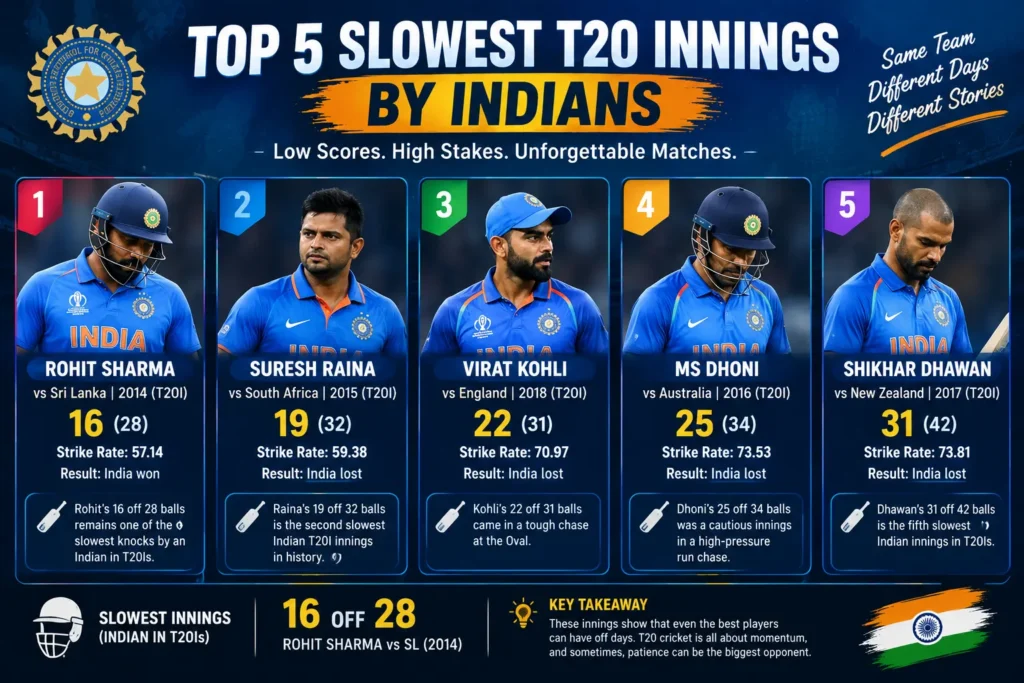
T20 cricket is generally associated with aggressive batting, quick running between the wickets, boundaries and high strike rates. With only 120 legal deliveries available to each team, batsmen are expected to make the most of almost every ball. However, even some of India’s most experienced and accomplished cricketers have played unusually slow innings in T20 internationals.
The Lowest Strike Rates: Top 5 Slowest T20 Innings by Indians is an interesting statistical topic because it highlights a different side of Indian T20 batting. Players such as MS Dhoni and Yuvraj Singh are widely remembered for their explosive hitting, yet both appear prominently when India’s slowest qualifying T20I innings are ranked by strike rate.
For this list, the focus is on men’s T20 internationals involving India, with a minimum qualification of 20 balls faced. This is important because without a minimum-ball requirement, a short innings such as a duck from one or two deliveries could technically produce an extremely low strike rate but would not provide a meaningful comparison.
Based on this criterion, MS Dhoni’s 9 off 27 balls against Australia in 2008 stands out as the slowest qualifying T20I innings by an Indian batter, with a strike rate of 33.33. Yuvraj Singh’s 14 not out from 32 balls against Pakistan and another slow Dhoni innings against West Indies follow it on the list.
These innings should not simply be labelled as failures. Match conditions, wickets, bowling quality, batting position and the tactical requirements of a particular situation can all influence a player’s scoring rate. That is why examining the context behind each innings is just as important as looking at the final numbers.
What Does Strike Rate Mean in T20 Cricket?
Strike rate is one of the most important statistics used to evaluate batting performances in limited-overs cricket.
The basic formula is:
Strike Rate = (Runs Scored ÷ Balls Faced) × 100
For example, if a batter scores 30 runs from 20 balls, the strike rate is 150.00. This means the player scored at a rate equivalent to 150 runs per 100 deliveries.
In T20 cricket, strike rate is particularly important because teams have a fixed limit of 120 legal deliveries in an innings. Unlike Test cricket, where occupying the crease for a long period can be a positive strategy, T20 teams generally need batsmen to score quickly.
A low strike rate does not automatically mean that a player had a completely ineffective innings. The circumstances of the match must also be considered. A batter might face a difficult pitch, high-quality bowling or arrive at the crease after several wickets have fallen.
This is why lowest strike rate in T20 innings by Indian batsmen should be viewed as a statistical category rather than a list of the worst players or worst performances.
The modern T20 game places considerable emphasis on aggressive batting and scoring efficiency. For broader information about international T20 cricket and official rankings, readers can also explore the ICC’s official T20 cricket coverage.
India’s T20I batting has also changed considerably over the years. Modern Indian batters are increasingly aggressive, with players capable of scoring at very high rates. This makes some of the slow innings from earlier periods particularly interesting when compared with today’s standards.
How Were the Top 5 Slowest T20 Innings Selected?
A clear qualification rule is necessary when discussing the slowest T20 innings by Indians.
For this ranking, the innings are considered from men’s T20 internationals played by India, with a minimum of 20 balls faced. Strike rate is used as the main ranking factor.
The minimum-ball rule prevents very short innings from dominating the statistics. For instance, a batter scoring zero runs from two balls technically has a strike rate of zero, but such an innings tells us very little about a player’s overall batting performance.
The ranking therefore focuses on innings where a player spent enough time at the crease for the scoring rate to become meaningful.
The top five under this methodology are:
| Rank | Player | Runs | Balls | Strike Rate | Opponent | Year |
| 1 | MS Dhoni | 9 | 27 | 33.33 | Australia | 2008 |
| 2 | Yuvraj Singh | 14* | 32 | 43.75 | Pakistan | 2016 |
| 3 | MS Dhoni | 11 | 23 | 47.82 | West Indies | 2009 |
| 4 | Bhuvneshwar Kumar | 16 | 32 | 50.00 | Sri Lanka | 2021 |
| 5 | Ravichandran Ashwin | 10 | 20 | 50.00 | New Zealand | 2016 |
These figures are based on the published ranking of India’s slowest T20I innings using the 20-ball qualification.
1. MS Dhoni – 9 Off 27 Balls vs Australia
MS Dhoni’s 9 runs from 27 balls against Australia in 2008 is the clearest entry at the top of India’s slowest T20I innings list.
The innings came at the Melbourne Cricket Ground on February 1, 2008. Dhoni scored only nine runs from 27 deliveries, producing a strike rate of 33.33. He did not hit a boundary during the innings.
For a player who became one of the most recognised finishers in T20 cricket, the numbers look particularly unusual. Dhoni was known for his ability to accelerate late in innings and attack fast bowlers, but this particular knock was completely different from that image.
One important factor is the era in which the innings was played. T20 international cricket was still relatively young in 2008. Modern T20 batting had not yet developed to the same extent, and teams were still experimenting with tactics and scoring strategies.
That does not change the fact that 9 off 27 is an extremely slow innings by T20 standards, but it provides useful context.
The innings also demonstrates why strike rate needs to be interpreted alongside match circumstances. A player can have a very low scoring rate because of bowling pressure, difficult batting conditions or an inability to find gaps.
Dhoni’s 2008 innings remains notable precisely because it is such an unusual statistical outlier compared with his overall reputation.
Among the Indian batsmen lowest strike rate records, this 33.33 strike rate remains the standout entry when a minimum of 20 balls is applied.
2. Yuvraj Singh – 14* Off 32 Balls vs Pakistan
Yuvraj Singh’s 14 not out from 32 balls against Pakistan in 2016 is another surprising entry.
Yuvraj was one of India’s most destructive limited-overs batsmen. His six sixes in an over against England remain one of the most famous moments in international cricket, and he regularly scored at a rapid rate during India’s successful white-ball campaigns.
Yet against Pakistan in Mirpur in 2016, Yuvraj scored only 14 runs from 32 balls, giving him a strike rate of 43.75.
The innings stands out because of the contrast between the player’s reputation and the scoring rate. A batter associated with powerful hitting found it extremely difficult to score freely during this particular match.
The knock also illustrates why statistics should not always be interpreted without context. T20 cricket can create situations where a batter has to prioritise survival, strike rotation or partnership building rather than immediate boundary hitting.
Yuvraj’s innings is therefore one of the most interesting examples of a slowest T20I knock by India because it came from a player who was normally associated with attacking cricket.
His presence near the top of the list also demonstrates how unusual a strike rate below 50 is for an established Indian T20 batsman.
A 43.75 strike rate means that Yuvraj scored fewer than 44 runs for every 100 balls at that particular rate. While that is extremely low by modern T20 standards, it represents one individual innings rather than his entire career.
3. MS Dhoni – 11 Off 23 Balls vs West Indies
MS Dhoni appears for a second time in the top five with his innings of 11 runs from 23 balls against the West Indies in 2009.
His strike rate was 47.82, which was considerably higher than his 33.33 strike rate against Australia but still very low for a T20 innings.
The match was played at Lord’s during the 2009 World Twenty20. India found themselves under early pressure after losing their first three wickets for 29 runs. Dhoni came to the crease in a difficult situation and eventually scored 11 from 23 deliveries.
The context makes the innings particularly interesting.
A batter arriving after early wickets can have a different responsibility from an opener walking in at 60/0. Losing another wicket immediately can put additional pressure on the batting side, so the player may initially concentrate on stabilising the innings.
However, T20 cricket also places a premium on acceleration, which creates a difficult balance.
Dhoni’s innings shows this tension clearly. His score was not large, and his strike rate was below what teams normally want in the format. At the same time, the broader innings situation explains why he may have been more cautious.
The match eventually saw Yuvraj Singh make a much more aggressive contribution, scoring 67 from 43 balls, but West Indies successfully chased India’s total and won by seven wickets.
This innings is therefore an important reminder that the lowest strike rate by Indian batsman does not necessarily tell the complete story of a match.
4. Bhuvneshwar Kumar – 16 Off 32 Balls vs Sri Lanka
Bhuvneshwar Kumar’s 16 runs from 32 balls against Sri Lanka in 2021 produced a strike rate of exactly 50.00.
Unlike Dhoni and Yuvraj, Bhuvneshwar was primarily selected as a bowler. That distinction is important when evaluating his batting.
A specialist bowler batting lower in the order is generally not expected to score at the same rate as an established top-order T20 batsman. If a player such as Bhuvneshwar comes to the crease late in an innings, the team’s circumstances may be very different.
His 32-ball innings was also notable because it contained no boundaries, according to the statistical breakdown of India’s slowest qualifying T20I innings.
Scoring 16 runs without a four or six means the majority of his contribution came through singles, twos and other non-boundary scoring.
This makes the innings a useful example of how slow batting innings in T20 cricket can develop. A batter may be unable to find boundaries but still attempt to remain at the crease and contribute whatever runs are possible.
The strike rate of 50.00 is low, but evaluating Bhuvneshwar’s innings exactly like a specialist top-order batsman would not be entirely fair.
His appearance in this list highlights another important factor: batting position and player role can have a major influence on strike rate.
5. Ravichandran Ashwin – 10 Off 20 Balls vs New Zealand
Ravichandran Ashwin completes the top five with 10 runs from 20 balls against New Zealand during the 2016 World Twenty20 in Nagpur.
His strike rate was exactly 50.00, the same as Bhuvneshwar Kumar’s innings.
However, Ashwin ranks below Bhuvneshwar in this particular list because both had the same strike rate, while Bhuvneshwar faced more deliveries.
Ashwin’s innings is another example of a lower-order player appearing in a list dominated by unusually slow knocks.
At the time, Ashwin was primarily recognised for his bowling rather than his batting. His job with the bat was often dependent on the match situation and the position at which he entered.
A 20-ball innings is long enough to qualify for this statistical list, but it still represents a relatively small sample compared with an opener’s entire T20 career.
The 50.00 strike rate means Ashwin scored one run for every two balls he faced. In a format where top-order players can regularly score at 140, 150 or even 180-plus strike rates, that is exceptionally slow.
Yet the number should be considered within the context of the player’s role.
This is one reason why T20 batting statistics are most useful when they are accompanied by information about batting position, match situation and team requirements.
Read More: Which IPL Team Has Most Fans in India? 2026 Fanbase Analysis
Comparing the Top 5 Slowest T20 Innings
The five innings provide several interesting patterns.
First, MS Dhoni appears twice. His 9 off 27 against Australia is comfortably the slowest of the five, while his 11 off 23 against West Indies occupies third position.
Yuvraj Singh’s 14 off 32 is second, while Bhuvneshwar Kumar and Ravichandran Ashwin both recorded a strike rate of 50.00.
There is also an interesting difference in player roles.
Dhoni and Yuvraj were established middle-order batsmen capable of playing aggressive innings. Bhuvneshwar and Ashwin were primarily bowling options. Therefore, their appearances should be interpreted differently.
The comparison can be summarised as follows:
- Lowest strike rate: MS Dhoni – 33.33
- Second-lowest: Yuvraj Singh – 43.75
- Third-lowest: MS Dhoni – 47.82
- Joint fifth position: Bhuvneshwar Kumar and Ravichandran Ashwin – 50.00
- Most balls faced among the five: Yuvraj Singh and Bhuvneshwar Kumar – 32 each
The broader statistical list also contains other notable slow innings from players such as Shikhar Dhawan, Ishan Kishan, Gautam Gambhir and Virat Kohli when the 20-ball qualification is used.
Why Strike Rate Alone Cannot Judge a T20 Innings
Strike rate is extremely useful, but it is not enough by itself to judge a batting performance.
Imagine a team loses three wickets inside the first five overs. A new batter may decide to spend several deliveries rebuilding the innings. If that player scores at a strike rate of 90 but helps prevent another collapse, the innings may have value.
Now consider another situation. A batter comes in during the final three overs with eight wickets in hand. If that player scores at a strike rate of 90, the same number might be considered disappointing because the team needs aggressive scoring at that stage.
This shows why lowest strike rate in T20I should not automatically be interpreted as poor batting.
Several factors can influence strike rate:
Pitch Conditions
A slow or uneven pitch can make boundary hitting difficult.
Bowling Quality
World-class bowlers can restrict scoring opportunities even in a format designed for aggressive batting.
Match Situation
A batter rebuilding an innings may initially focus on survival.
Batting Position
Openers and finishers have very different responsibilities.
Wickets Available
A team with several wickets in hand can afford more aggressive shots than a team already under pressure.
Required Run Rate
The target and current scoring rate can dramatically change the value of an individual innings.
For this reason, the slowest T20 innings by Indians should be viewed as statistical curiosities and points for analysis rather than simple rankings of batting failures.
Slowest T20 Innings vs Lowest Strike Rate: What Is the Difference?
The terms “slowest innings” and “lowest strike rate” are often used interchangeably, but they can describe slightly different statistical approaches.
An innings can be called slow because a batter faced a large number of deliveries. Another ranking may define “slowest” specifically by strike rate.
For example, an innings of 20 runs from 40 balls has a strike rate of 50.00, while an innings of 5 runs from 20 balls has a strike rate of 25.00.
The second innings has the lower strike rate, but the first batter consumed twice as many deliveries.
This is why rankings should always state their qualification rules.
Some statistical lists use a minimum of 20 balls faced, while others may use 30 or 40 balls, or introduce a minimum-run requirement.
For readers researching lowest strike rate by Indian batsman, checking the methodology is therefore essential.
The 20-ball method used here produces a balanced list because it removes extremely short innings while still allowing enough qualifying performances to make a meaningful top five.
How India’s T20 Batting Has Changed Over the Years
The evolution of India’s T20 batting makes these slow innings even more interesting.
In the early years of international T20 cricket, teams were still developing their approach to the format. Batters were learning how to balance risk and reward across only 120 balls.
The modern game is considerably more aggressive.
Contemporary Indian T20 batting increasingly focuses on power hitting, boundary percentage, strike rotation and attacking matchups. The contrast can be seen in recent performances from players such as Abhishek Sharma and Ishan Kishan.
The ICC’s men’s T20I batting rankings and statistics also show how modern T20 batting is increasingly evaluated through detailed statistical performance.
Modern players have access to extensive data, matchup analysis, specialised batting roles and aggressive field strategies.
As a result, a strike rate that might have seemed acceptable in one period can appear extremely slow in another.
Famous Indian Batsmen and Their Slow T20 Knocks
Several famous Indian players have appeared in India’s slowest T20 innings statistics.
MS Dhoni is the most prominent name in the top five, appearing twice.
Yuvraj Singh is another major name. His reputation as a powerful six-hitter makes his 14 off 32 balls against Pakistan particularly surprising.
Other names appearing further down the qualifying list include Shikhar Dhawan, Ishan Kishan, Gautam Gambhir and Virat Kohli.
This is important because it demonstrates that even elite batsmen can have innings where their normal scoring rate disappears.
A player’s career strike rate is a completely different statistic from the strike rate of one innings. A batter can maintain an excellent career record while still having an occasional unusually slow knock.
Career statistics are therefore better for judging long-term performance, while individual innings statistics are useful for identifying unusual performances and match-specific situations.
The Importance of Context in Indian T20I Batting Records
When studying Indian T20I batting records, it is easy to focus only on numbers.
However, the most useful statistical analysis combines numbers with context.
For example, a batter’s 50 runs from 30 balls might look excellent. But if the team required 80 runs from those 30 balls and the batter was dismissed with the game almost lost, the value of that innings changes.
Similarly, a 20-ball 10 may look poor on paper. But if the batter is a tailender protecting a recognised batsman from the strike or trying to survive against a difficult attack, the circumstances are different.
This is particularly relevant to Bhuvneshwar Kumar and Ravichandran Ashwin in this ranking.
The role of a player should always be considered when analysing a lowest batting strike rate India record.
Frequently Asked Questions
What is the lowest strike rate by an Indian batsman in T20I?
Using a minimum qualification of 20 balls faced, MS Dhoni’s 9 runs from 27 balls against Australia in 2008 is the lowest qualifying strike rate at 33.33.
Who played the slowest T20I innings for India?
MS Dhoni played the slowest qualifying T20I innings for India under the 20-ball criterion. He scored 9 from 27 balls against Australia at the Melbourne Cricket Ground in 2008.
What was MS Dhoni’s strike rate in his slowest T20I innings?
Dhoni’s strike rate was 33.33, based on nine runs from 27 deliveries.
Why is a minimum number of balls required?
A minimum-ball qualification prevents very short innings from distorting the ranking. Without it, a batter scoring zero from one or two balls could appear at the top even though the sample is too small to provide useful information.
Did MS Dhoni appear more than once in the list?
Yes. Dhoni appears twice in the top five, with 9 off 27 balls against Australia and 11 off 23 balls against West Indies.
Is a low strike rate always a bad thing in T20 cricket?
No. Match circumstances are extremely important. Pitch conditions, bowling quality, wickets lost, batting position and required run rate can all influence a batter’s scoring rate.
Which Indian players have other slow T20I innings?
The broader 20-ball list includes Yuvraj Singh, Shikhar Dhawan, Ishan Kishan, Gautam Gambhir and Virat Kohli among others.
Why are modern T20 strike rates generally higher?
Modern T20 cricket has become more specialised and aggressive. Players have greater access to data, improved fitness and power-hitting techniques, while teams increasingly plan batting around matchups and boundary scoring.
What is considered a good T20 strike rate?
There is no single number that defines a good strike rate for every player. Openers, middle-order batsmen, finishers and lower-order players have different roles. A strike rate should therefore be evaluated alongside batting position, match situation and overall contribution.
Final Verdict
The Lowest Strike Rates: Top 5 Slowest T20 Innings by Indians provide an unusual look at India’s T20I history.
MS Dhoni’s 9 off 27 balls against Australia remains the standout example under the 20-ball qualification, with a strike rate of only 33.33. Yuvraj Singh’s 14 off 32 balls, Dhoni’s second entry of 11 off 23, Bhuvneshwar Kumar’s 16 off 32 and Ravichandran Ashwin’s 10 off 20 complete the top five.
What makes these innings interesting is not simply that they were slow. It is the identity of the players involved and the different circumstances surrounding each performance.
Dhoni and Yuvraj were recognised as aggressive white-ball batsmen, while Bhuvneshwar and Ashwin were primarily bowling options. Their presence on the list therefore has different meanings.
The biggest lesson is that strike rate is an important T20 statistic, but it is not a complete measure of batting quality. A scorecard can tell us how many runs a player scored and how many balls they faced, but the match situation tells us why the innings developed that way.
For readers interested in slowest T20I innings by Indian batsman, these five performances provide a fascinating statistical snapshot of how even India’s biggest cricket stars have occasionally struggled to score freely.
As modern T20 cricket continues to become faster and more aggressive, these older slow-scoring innings are likely to become even more unusual. They remain valuable not simply as records, but as reminders that every T20 innings is shaped by its own combination of players, pressure, conditions and circumstances.