
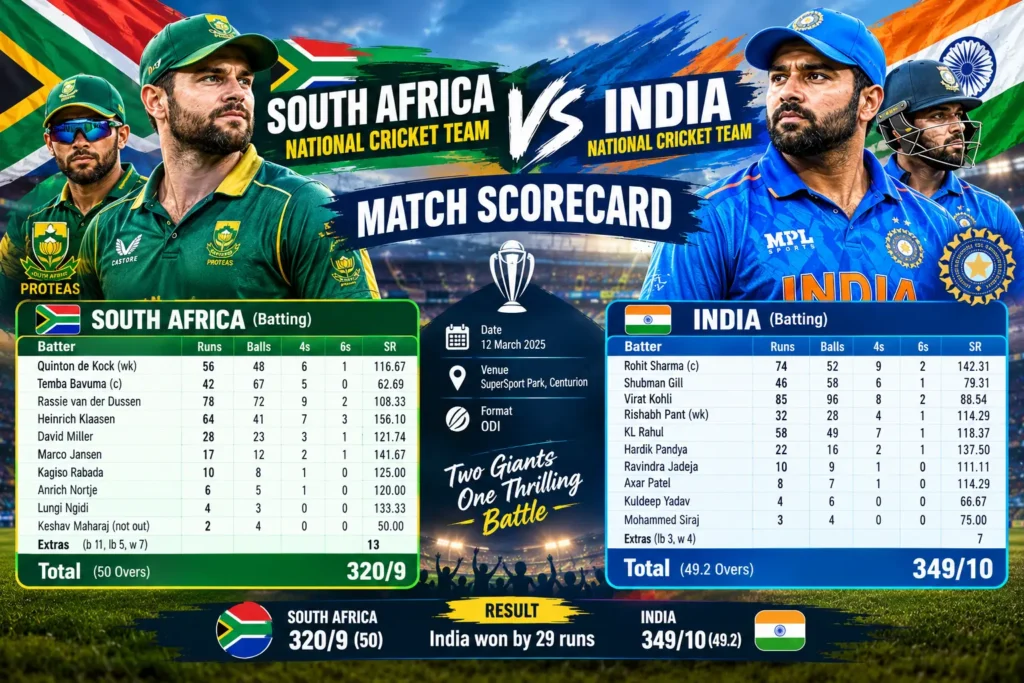
The South Africa national cricket team vs India national cricket team match scorecard provides a complete overview of one of international cricket’s most competitive rivalries. From high-scoring T20 matches to closely contested ODIs and Test series, South Africa and India have produced memorable performances featuring powerful batters, quality fast bowlers and match-changing all-rounders.
One of the standout recent meetings between the two teams took place on 22 February 2026 during the ICC Men’s T20 World Cup Super Eight stage at Narendra Modi Stadium in Ahmedabad, India. South Africa won the match by 76 runs after scoring 187/7 in 20 overs. India were bowled out for 111 in 18.5 overs while chasing a target of 188.
David Miller led South Africa’s recovery with 63 runs, while Tristan Stubbs added an unbeaten 44. Marco Jansen then delivered an outstanding bowling performance, taking four wickets for 22 runs. For India, Shivam Dube top-scored with 42, but South Africa’s bowlers maintained pressure throughout the chase.
This guide covers the match scorecard, batting and bowling figures, key performances, turning points, match analysis and frequently asked questions about South Africa vs India cricket matches.
South Africa vs India Match Summary
South Africa won the toss and elected to bat first. India made an excellent start with the ball, reducing South Africa to 20/3. However, David Miller and Dewald Brevis rebuilt the innings with an important partnership, followed by a late contribution from Tristan Stubbs.
South Africa reached 187/7 in its allotted 20 overs. India needed 188 runs to win but lost early wickets and struggled to establish a partnership. Shivam Dube offered some resistance with 42 runs, yet Marco Jansen and Keshav Maharaj took important wickets to keep India behind the required run rate.
India were eventually dismissed for 111, giving South Africa a convincing 76-run victory.
Match Details
| Match Information | Details |
| Match | South Africa vs India |
| Tournament | ICC Men’s T20 World Cup 2026 |
| Stage | Super Eight |
| Date | 22 February 2026 |
| Format | Twenty20 International |
| Venue | Narendra Modi Stadium, Ahmedabad, India |
| Toss | South Africa won and elected to bat |
| South Africa Score | 187/7 in 20 overs |
| India Score | 111 all out in 18.5 overs |
| Target | 188 runs |
| Result | South Africa won by 76 runs |
| Player of the Match | David Miller |
For the official tournament result, see the ICC India vs South Africa match page.
South Africa Batting Scorecard
South Africa’s innings began with early pressure from India’s fast bowlers. Aiden Markram, Quinton de Kock and Ryan Rickelton were dismissed before the team could establish a substantial opening partnership.
With the score at 20/3, South Africa needed a recovery. Dewald Brevis and David Miller responded with aggressive but controlled batting, taking advantage of scoring opportunities and putting pressure back on India’s bowlers.
Miller scored 63 from 35 balls, while Brevis contributed 45 from 29 deliveries. Tristan Stubbs then provided an important late boost, finishing unbeaten on 44 from 24 balls. These performances helped South Africa reach 187/7.
South Africa Batting Table
| Batter | Runs | Balls | 4s | 6s | Strike Rate |
| Aiden Markram (c) | 4 | 7 | 0 | 0 | 57.14 |
| Quinton de Kock (wk) | 6 | 7 | 1 | 0 | 85.71 |
| Ryan Rickelton | 7 | 7 | 0 | 1 | 100.00 |
| Dewald Brevis | 45 | 29 | 3 | 3 | 155.17 |
| David Miller | 63 | 35 | 7 | 3 | 180.00 |
| Tristan Stubbs | 44* | 24 | 1 | 3 | 183.33 |
| Marco Jansen | 2 | 6 | 0 | 0 | 33.33 |
| Corbin Bosch | 5 | 6 | 1 | 0 | 83.33 |
| Kagiso Rabada | 0* | 1 | 0 | 0 | 0.00 |
| Keshav Maharaj | Did not bat | — | — | — | — |
| Lungi Ngidi | Did not bat | — | — | — | — |
Extras: 11
Total: 187/7 in 20 overs
Note: An asterisk indicates that the batter remained not out.
David Miller’s Match-Winning Innings
David Miller was the leading run-scorer for South Africa, making 63 from 35 balls with seven fours and three sixes. His innings was particularly valuable because South Africa had lost three early wickets.
Miller focused on rebuilding the innings before accelerating when scoring opportunities appeared. His ability to find gaps and clear the boundary helped South Africa recover from a difficult start.
His partnership with Dewald Brevis was one of the most important phases of the match. Together, they added 97 runs from 51 balls, shifting momentum in South Africa’s favour and giving the team a competitive total.
Miller’s contribution earned him the Player of the Match award.
Dewald Brevis and Tristan Stubbs Add Momentum
Dewald Brevis scored 45 runs from 29 balls, including three fours and three sixes. His attacking approach complemented Miller’s innings and prevented India from controlling the middle overs.
Tristan Stubbs provided another crucial contribution at the end of the innings. His unbeaten 44 from 24 balls, including three sixes, helped South Africa finish strongly after losing wickets earlier.
The combination of Miller’s experience, Brevis’s aggressive batting and Stubbs’s late acceleration allowed South Africa to reach a total that put significant pressure on India.
India Bowling Scorecard
India began the match strongly with the ball. Jasprit Bumrah removed Quinton de Kock and Ryan Rickelton, while Arshdeep Singh dismissed Aiden Markram. South Africa’s score fell to 20/3, putting the batting side under immediate pressure.
However, India could not prevent Miller and Brevis from building their partnership. South Africa accelerated in the middle overs and finished with 187 runs.
India Bowling Figures
| Bowler | Overs | Maidens | Runs | Wickets | Economy |
| Arshdeep Singh | 4 | 0 | 28 | 2 | 7.00 |
| Jasprit Bumrah | 4 | 0 | 15 | 3 | 3.75 |
| Varun Chakaravarthy | 4 | 0 | 47 | 1 | 11.75 |
| Washington Sundar | 2 | 0 | 17 | 0 | 8.50 |
| Hardik Pandya | 4 | 0 | 45 | 0 | 11.25 |
| Shivam Dube | 2 | 0 | 32 | 1 | 16.00 |
Jasprit Bumrah was India’s most economical frontline bowler, finishing with three wickets for 15 runs in four overs. His early breakthroughs gave India a strong start.
Arshdeep Singh also contributed two wickets, while Shivam Dube dismissed Dewald Brevis. However, India struggled to contain the scoring rate during the partnership between Miller and Brevis.
Varun Chakaravarthy took one wicket but conceded 47 runs in four overs. The inability to break the main partnership earlier allowed South Africa to recover and post a challenging score.
India Batting Scorecard
India began the chase of 188 runs under pressure. South Africa attacked from the opening over, using disciplined bowling and effective fielding to create early opportunities.
Ishan Kishan was dismissed for a duck, and Tilak Varma also fell for one run. Abhishek Sharma scored 15, but India continued to lose wickets during the powerplay and middle overs.
Shivam Dube was the most successful Indian batter, scoring 42 from 37 balls. He hit three sixes and one four, attempting to rebuild the innings after several top-order wickets. Hardik Pandya added 18 runs, while Washington Sundar scored 11.
India were eventually bowled out for 111 in 18.5 overs.
India Batting Table
| Batter | Runs | Balls | 4s | 6s | Strike Rate |
| Ishan Kishan (wk) | 0 | 4 | 0 | 0 | 0.00 |
| Abhishek Sharma | 15 | 12 | 2 | 1 | 125.00 |
| Tilak Varma | 1 | 2 | 0 | 0 | 50.00 |
| Suryakumar Yadav (c) | 18 | 22 | 2 | 0 | 81.81 |
| Washington Sundar | 11 | 11 | 0 | 1 | 100.00 |
| Shivam Dube | 42 | 37 | 1 | 3 | 113.51 |
| Hardik Pandya | 18 | 17 | 0 | 1 | 105.88 |
| Rinku Singh | 0 | 2 | 0 | 0 | 0.00 |
| Arshdeep Singh | 1 | 2 | 0 | 0 | 50.00 |
| Varun Chakaravarthy | 0* | 3 | 0 | 0 | 0.00 |
| Jasprit Bumrah | 0 | 1 | 0 | 0 | 0.00 |
Extras: 5
Total: 111 all out in 18.5 overs
Shivam Dube’s Resistance
Shivam Dube scored 42 runs from 37 balls and was India’s highest scorer in the innings. While wickets continued to fall at the other end, Dube attempted to keep the chase alive by finding boundaries and rotating the strike.
His innings included three sixes and one four. However, the regular loss of wickets meant that India could not build the partnerships needed to approach the target.
Dube’s dismissal in the 19th over effectively ended India’s remaining resistance. South Africa then took the final wicket in the same over to complete the victory.
South Africa Bowling Scorecard
South Africa’s bowling was decisive in defending 187 runs. The bowlers took early wickets, maintained pressure during the middle overs and prevented India from establishing a long partnership.
Marco Jansen was the standout performer, claiming four wickets for 22 runs. Keshav Maharaj took three wickets, while Corbin Bosch claimed two. Aiden Markram and the other bowlers also played important roles in restricting India’s scoring.
South Africa Bowling Figures
| Bowler | Overs | Maidens | Runs | Wickets | Economy |
| Aiden Markram | 1 | 0 | 5 | 1 | 5.00 |
| Marco Jansen | 3.5 | 0 | 22 | 4 | 5.73 |
| Kagiso Rabada | 4 | 0 | 32 | 0 | 8.00 |
| Lungi Ngidi | 4 | 0 | 15 | 0 | 3.75 |
| Keshav Maharaj | 3 | 0 | 24 | 3 | 8.00 |
| Corbin Bosch | 3 | 0 | 12 | 2 | 4.00 |
Marco Jansen’s Four-Wicket Spell
Marco Jansen took four wickets for 22 runs in 3.5 overs. His spell was one of the main reasons India could not recover from its poor start.
Jansen dismissed Abhishek Sharma and Tilak Varma during the early stages of the innings, putting India’s batting line-up under additional pressure. He returned later to remove Shivam Dube and Jasprit Bumrah, finishing the innings and confirming South Africa’s win.
His pace, variations and ability to take wickets at important moments made him South Africa’s leading bowler in the match.
Read More: Australian Men’s Cricket Team vs India National Cricket Team Match Scorecard
Keshav Maharaj Changes the Game
Keshav Maharaj claimed three wickets for 24 runs. His spell proved particularly damaging during the middle overs, when India needed to rebuild its innings.
Maharaj dismissed Hardik Pandya, Rinku Singh and Arshdeep Singh in a short period. Those wickets stopped India from developing a partnership and left the lower order with an increasingly difficult task.
Corbin Bosch also made an impact, taking two wickets for 12 runs in three overs. Together, South Africa’s bowlers ensured that India never established the momentum required for a successful chase.
Key Turning Points in South Africa vs India
1. South Africa Lost Three Early Wickets
India’s bowlers made an excellent start by reducing South Africa to 20/3. At that point, the batting side was under pressure to rebuild its innings and avoid an early collapse.
2. Miller and Brevis Rebuilt the Innings
The 97-run partnership between David Miller and Dewald Brevis changed the match. Their aggressive scoring helped South Africa recover from its early setbacks and put pressure back on India’s bowlers.
3. Tristan Stubbs Accelerated at the End
Stubbs’s unbeaten 44 from 24 balls provided valuable runs in the final overs. His contribution helped South Africa finish on 187/7 rather than leaving India with a more manageable target.
4. India Lost Early Wickets in the Chase
India’s chase quickly became difficult after early dismissals. The loss of wickets in the powerplay increased the required scoring rate and prevented the team from building a stable opening partnership.
5. Jansen and Maharaj Dismissed Key Batters
Jansen’s four wickets and Maharaj’s three-wicket haul removed important Indian batters. Their performances ensured that India could not recover despite Dube’s 42 runs.
South Africa vs India Head-to-Head Record
South Africa and India have competed against each other in all three major international formats: Test cricket, One Day Internationals and Twenty20 Internationals.
The rivalry has produced different types of contests depending on the format and playing conditions. Test matches often feature extended battles between fast bowlers and specialist batters. ODIs require teams to balance scoring speed with wicket preservation, while T20Is reward quick scoring, tactical bowling changes and effective fielding.
For an accurate head-to-head section, records should be presented separately for each format and updated using current statistics. A complete table should include:
| Format | Statistics to Include |
| Test | Matches played, South Africa wins, India wins, draws and ties |
| ODI | Matches played, wins for both teams, ties and no-results |
| T20I | Matches played, wins for both teams, ties and no-results |
These totals should be checked before publication because new international matches can change the records. Avoid combining results from Tests, ODIs and T20Is into one total without clearly explaining the methodology.
Difference Between Test, ODI and T20I Scorecards
The South Africa national cricket team vs India national cricket team match scorecard can look different depending on the format.
Test cricket: Each team can bat twice, and matches may last up to five days. The scorecard includes innings totals, individual batting figures, bowling figures and the final result, which can be a win, loss, draw or tie.
One Day International: Each team normally has a maximum of 50 overs. Scorecards show batting and bowling figures, extras, fall of wickets and the result of the chase or first innings.
Twenty20 International: Each team normally has a maximum of 20 overs. Batters often score at a faster rate, so strike rate, boundaries and economy rate are particularly useful when comparing performances.
In the 2026 T20 World Cup match, South Africa’s total of 187/7 gave India a target of 188. India’s total of 111 all out meant South Africa won by 76 runs.
How to Read a Cricket Match Scorecard
A scorecard uses abbreviations to summarise individual performances.
- R (Runs): Total runs scored by a batter.
- B (Balls): Deliveries faced by the batter.
- 4s: Number of fours hit.
- 6s: Number of sixes hit.
- SR (Strike Rate): Runs scored per 100 balls faced.
- O (Overs): Overs bowled by a bowler.
- M (Maidens): Maiden overs bowled.
- W (Wickets): Wickets taken by a bowler.
- Econ (Economy Rate): Average runs conceded per over.
- Extras: Runs awarded through wides, no-balls, byes, leg-byes and other extras.
- Fall of Wickets: The score and over at which each batter was dismissed.
For example, David Miller’s 63 from 35 balls shows that he scored quickly while helping South Africa recover from early wickets. Marco Jansen’s figures of 4/22 indicate that he took four wickets while conceding 22 runs.
These statistics help readers compare batting contributions, bowling efficiency and the overall impact of individual players.
Frequently Asked Questions
Who won the South Africa vs India match on 22 February 2026?
South Africa won by 76 runs in the Super Eight stage of the ICC Men’s T20 World Cup 2026. South Africa scored 187/7, while India were dismissed for 111 in 18.5 overs.
What was South Africa’s score against India?
South Africa scored 187 runs for seven wickets in 20 overs. David Miller scored 63, Dewald Brevis made 45 and Tristan Stubbs remained unbeaten on 44.
What was India’s score against South Africa?
India scored 111 all out in 18.5 overs. Shivam Dube was India’s highest scorer with 42 runs from 37 balls.
Who was Player of the Match?
David Miller was named Player of the Match for his important innings of 63 runs from 35 balls.
How many wickets did Marco Jansen take?
Marco Jansen took four wickets for 22 runs in 3.5 overs. He was South Africa’s leading wicket-taker in the match.
How many wickets did Jasprit Bumrah take?
Jasprit Bumrah took three wickets for 15 runs in four overs, giving India an excellent start with the ball.
Where was the South Africa vs India match played?
The match was played at Narendra Modi Stadium in Ahmedabad, India, on 22 February 2026.
What was the target for India?
India needed 188 runs to win after South Africa finished its innings on 187/7.
Where can I find the official South Africa vs India scorecard?
You can check the official match information and scorecard through the BCCI match centre.
What is the difference between a batting scorecard and a bowling scorecard?
A batting scorecard shows how many runs each batter scored, the number of balls faced, boundaries and strike rate. A bowling scorecard shows overs bowled, runs conceded, wickets taken and economy rate.
Final Match Result
The South Africa national cricket team vs India national cricket team match on 22 February 2026 was decided by South Africa’s recovery with the bat and its disciplined bowling performance.
After falling to 20/3, South Africa recovered to post 187/7, led by David Miller’s 63 and Dewald Brevis’s 45. Tristan Stubbs added an unbeaten 44 to strengthen the total.
India struggled during the chase and lost wickets at regular intervals. Shivam Dube scored 42, but Marco Jansen’s four wickets and Keshav Maharaj’s three wickets ensured that South Africa remained in control. India were bowled out for 111, giving South Africa a 76-run victory.
For readers following South Africa vs India cricket, this match is a strong example of how a middle-order partnership and effective bowling can overcome early setbacks and decide a high-pressure T20 contest.