
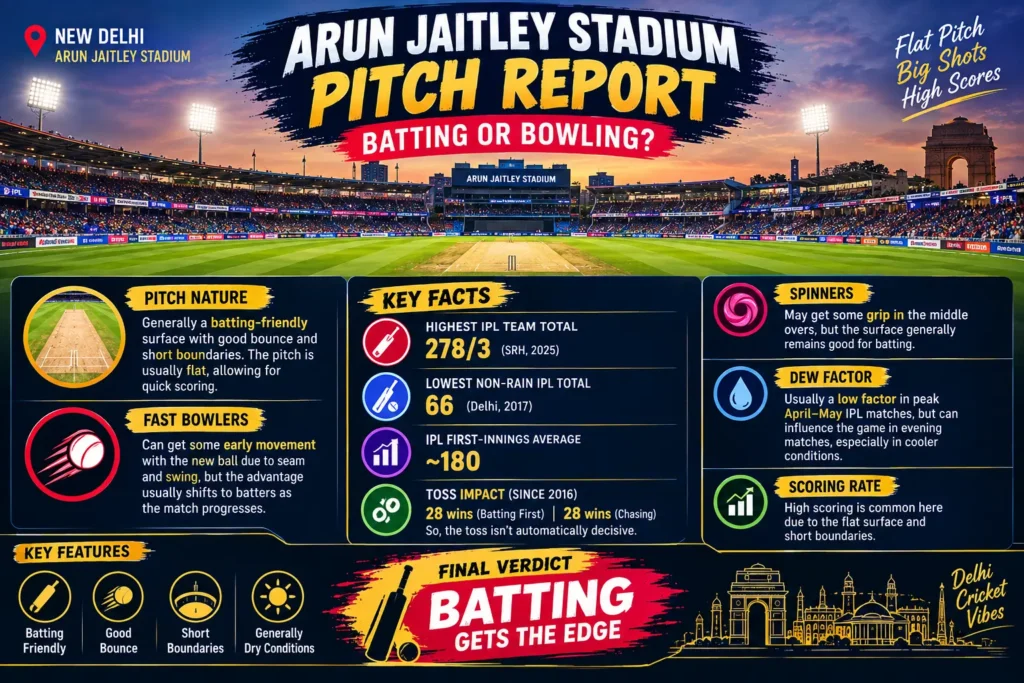
When cricket fans search for an Arun Jaitley Stadium pitch report batting or bowling, they usually want one simple answer: will the pitch help batters or bowlers? The reality at Delhi’s Arun Jaitley Stadium is a little more interesting. The surface has historically been regarded as batting-friendly, but its behaviour can change according to the format, pitch strip, weather and stage of the match.
In T20 and IPL cricket, the venue can produce quick scoring because batters get good value for shots and the boundaries are relatively accessible. Recent IPL matches have produced huge totals, including 264/2 by Delhi Capitals and a successful 265/4 chase by Punjab Kings in 2026. At the same venue, however, Delhi were dismissed for only 75 against Royal Challengers Bengaluru, showing that the ground does not automatically guarantee a high-scoring innings.
The modern Arun Jaitley Stadium pitch is therefore best described as batting-friendly in white-ball cricket, with enough assistance for bowlers who use the right tactics. Fast bowlers can make an impact with the new ball, while spinners and slower-ball specialists can become important when the surface slows down.
In this detailed guide, we will examine the Arun Jaitley Stadium batting pitch, bowling conditions, spin versus pace, IPL and T20 behaviour, average scores, dew, toss, chasing, boundary dimensions and recent match trends.
Arun Jaitley Stadium Pitch – Quick Overview
| Factor | Typical Behaviour |
|---|---|
| Overall T20 nature | Batting-friendly |
| Pace | Good value when the ball comes on |
| Bounce | Moderate, with some variation possible |
| Spin | Useful in middle overs |
| New-ball bowling | Can provide early assistance |
| Outfield | Generally quick |
| Boundaries | Relatively short |
| Dew | Can influence night matches |
| IPL first-innings average | Around 170+ |
| Best batting approach | Positive but selective |
| Best bowling approach | Variations and disciplined lengths |
Recent IPL venue data gives a useful snapshot. In the 2026 IPL season, Arun Jaitley Stadium had an average first-innings score of 173, while the highest total recorded in the season was 265/4. The same venue also produced a low score of 75 all out.
That range tells us something important: this is not a venue where one simple label explains everything.
A batter-friendly pitch can still become difficult when batters choose poor shots, bowlers hit the right areas or the surface offers less pace than expected.
For readers looking for more stadium-specific cricket analysis, an internal link to your [Eden Gardens pitch report] would fit naturally here because both venues can show significant differences between IPL and longer-format conditions.
Is Arun Jaitley Stadium a Batting or Bowling Pitch?
The short answer is: it generally favours batting in T20 and IPL cricket, but good bowling can still have a major influence.
The official IPL match information from recent Delhi games has repeatedly classified the conditions around the venue as fast-and-bounce/average. In one 2026 match between Delhi Capitals and Chennai Super Kings, the pitch was listed as “Fast & Bounce / Average” for batting, with pace-and-bounce conditions also rated average for bowling.
That is a useful description because it shows that “batting pitch” does not mean the surface is completely flat.
Why the Pitch Favors Batters
There are several reasons why the Arun Jaitley Stadium batting pitch can be attractive to modern T20 batters.
The first is the boundary size. Recent IPL venue information listed the straight boundary at around 68 metres and the square boundaries at approximately 63–67 metres. These dimensions give aggressive batters plenty of opportunities to clear the ropes.
The second factor is the outfield. A well-timed shot can travel quickly once it gets through the infield.
The third is the pace of the surface. When the pitch is hard and the ball comes nicely onto the bat, stroke-makers can play through the line and attack both sides of the ground.
Recent results support this reputation. Delhi Capitals scored 264/2 against Punjab Kings in IPL 2026, after which Punjab successfully chased 265/4.
That match is an excellent example of what can happen when top-order batters settle on this type of surface.
Why Bowlers Can Still Dominate
Calling Delhi a batting ground should not lead to the assumption that bowlers are irrelevant.
Fast bowlers can get some help with the new ball, particularly if they hit a disciplined length and extract movement. Once the ball becomes older, cutters and slower deliveries can become useful against batters who are trying to attack the shorter boundaries.
Spinners can also play a role in the middle overs. Their biggest challenge is that a small error in length can disappear for six, but accurate spin can restrict the scoring rate and create wicket-taking opportunities.
The clearest evidence is the 2026 IPL match in which Delhi were bowled out for 75 against RCB. RCB then reached 77/1 in only 10.1 overs.
So the better conclusion is that the pitch gives batters a high ceiling, but bowlers can still control matches through accuracy, variation and intelligent match-ups.
Arun Jaitley Stadium T20 Pitch Report
T20 cricket brings out the most batting-friendly characteristics of the Delhi venue.
The powerplay can be particularly useful for aggressive opening batters because only two fielders are allowed outside the circle. If the ball is coming onto the bat, top-order players can attack the gaps and target the shorter boundary.
At the same time, the first few overs can offer fast bowlers their best opportunity.
A bowler who gets the ball to move slightly or consistently hits a good length can put the batting side under pressure before the surface becomes easier to score on.
Powerplay Conditions
The new ball is the main weapon for fast bowlers.
Batters need to be careful about chasing deliveries outside off stump, particularly when there is movement.
Once the ball stops moving, however, the advantage can shift quickly towards the batting side.
Middle Overs
The middle overs are where spin and pace variations become particularly important.
Spinners can slow the game down by varying flight and pace, while batters will generally look to rotate the strike rather than attempt a boundary from every delivery.
This phase can determine whether a team finishes around 165 or pushes towards 190-plus.
Death Overs
The final five overs are usually the most dangerous period for bowlers.
The combination of short boundaries and established batters means even small mistakes can be punished.
Yorkers, wide yorkers and well-disguised slower balls are therefore more valuable than predictable pace.
For more detailed IPL venue research, your [IPL pitch reports] or [T20 pitch report] article would be a natural internal link from this section.
Arun Jaitley Stadium IPL Pitch Report
The IPL is probably the best competition for understanding the modern white-ball character of the Delhi surface.
The 2026 season produced a wide range of results. Delhi Capitals made 164/4 against Mumbai Indians, 209/8 against Gujarat Titans, 264/2 against Punjab Kings and 197/5 against Rajasthan Royals. On the other side, Delhi were dismissed for 75 against RCB and 142/8 against Kolkata Knight Riders.
These results demonstrate that the venue can support both high-scoring cricket and strong bowling performances.
In the Delhi Capitals versus Rajasthan Royals match on May 17, 2026, Delhi made 197/5 and Rajasthan responded with 193/8. The official IPL scorecard classified the batting and bowling conditions as fast-and-bounce/average.
Similarly, against KKR, Delhi scored 142/8 before Kolkata chased the target with 147/2. The official match information again listed the conditions as fast-and-bounce/average.
This makes the Arun Jaitley Stadium IPL pitch report more nuanced than simply saying “flat pitch.”
It is capable of supporting big totals, but the actual result depends heavily on batting execution and bowling plans.
Arun Jaitley Stadium Pitch Conditions for Batting
For batters, the biggest attraction is the combination of surface, boundaries and outfield.
Once a batter understands the pace of the wicket, stroke-making can become easier. Pull shots, cuts, drives and lofted shots can all become effective depending on the bowler’s length.
The shorter square boundaries also encourage batters to use horizontal-bat shots.
However, attacking every delivery is not necessarily the best strategy.
A smart batter first reads the pitch and then identifies which bowlers can be attacked. This is particularly important in Delhi because one over of poor shot selection can completely change the momentum.
The best approach is often:
- watch the first few deliveries;
- identify whether the ball is coming on quickly;
- target the shorter side;
- rotate against quality spin;
- preserve wickets for the death overs.
Top-order players naturally have an advantage because they have more time to settle and exploit the conditions.
Read More: Eden Gardens Stadium Pitch Report
Arun Jaitley Stadium Bowling Conditions
The bowling conditions at Delhi are more tactical than the reputation of the venue might suggest.
Fast bowlers should generally use the new ball aggressively. Swing, seam and disciplined lengths can create chances before batters become comfortable.
Later, pace variation becomes increasingly important.
A cutter that grips slightly can be more effective than a fast delivery that sits perfectly in the batter’s hitting zone.
At the death, yorkers are especially important because short boundaries punish missed lengths.
Spinners face a different challenge.
The boundaries make defensive bowling difficult, but a spinner who changes flight, pace and angle can still create pressure. Bowling too full or too short can be punished, so consistency is essential.
The official IPL match data from the 2026 Delhi versus Chennai Super Kings game described both batting and bowling conditions as fast-and-bounce/average, which reinforces the idea that bowlers can compete when they execute properly.
Arun Jaitley Stadium Spin vs Pace
The battle between spin and pace depends strongly on the format and match conditions.
| Bowling Type | Best Phase | Main Weapon |
|---|---|---|
| Fast bowling | Powerplay | Swing and seam |
| Fast-medium | Middle overs | Cutters |
| Finger spin | Middle overs | Control |
| Wrist spin | Middle overs | Flight and variation |
| Fast bowling | Death | Yorkers |
| Slower balls | Death | Disrupting timing |
Historically, the venue has been regarded as batting-friendly, but its longer-format history also shows why spinners should not be ignored. Cricbuzz describes the ground’s pitch as largely batting-friendly over the years, while its historical record includes some famous spin performances.
The most famous example is Anil Kumble’s remarkable 10/74 against Pakistan in 1999, when he became only the second bowler at the time to take all ten wickets in a Test innings.
That historical background is important because it shows that the ground’s reputation changes significantly depending on whether the match is a T20 or a Test.
Arun Jaitley Stadium Pitch Report for Test Matches
Test cricket at Arun Jaitley Stadium should not be analysed in exactly the same way as IPL cricket.
A Test pitch has much more time to change.
A surface that looks good for batting on day one can become increasingly challenging as the match progresses. Dry conditions can help spinners extract more turn and variable bounce later in the game.
Cricbuzz’s historical venue statistics show a substantial difference between first-innings and fourth-innings scoring: the average first innings is listed at 345, while the fourth innings average is 161.
That is a major difference.
It suggests that the surface and match situation can become significantly more difficult for teams batting last.
For anyone searching for an Arun Jaitley Stadium Test pitch report, the key takeaway is therefore simple: the venue can be good for batting early but becomes increasingly interesting for spin as the match develops.
The ground’s Test history also includes some of Indian cricket’s most memorable bowling performances, which adds to its reputation as a venue where spinners can eventually become decisive.
Arun Jaitley Stadium ODI Pitch Report
ODI cricket sits between the T20 and Test versions of the ground.
The surface can support good run-scoring, but the middle overs create opportunities for spin and changes of pace.
Cricbuzz’s venue statistics list an ODI first-innings average of 244 and a second-innings average of 213. The highest ODI total listed is 428/5 by South Africa against Sri Lanka.
That shows that the venue is capable of producing very high ODI totals.
However, the average is much lower than the biggest scores, meaning conditions can vary considerably.
In a 50-over match, teams should therefore focus on preserving wickets. A side that reaches the final 10 overs with eight or nine wickets intact can accelerate significantly.
For readers searching for an Arun Jaitley Stadium ODI pitch report, the best description is balanced-to-batting-friendly, with spin and pace variations becoming important during the middle overs.
Arun Jaitley Stadium Average Score
Average score is one of the most searched statistics in any stadium pitch report, but it needs context.
For IPL cricket, recent 2026 venue data lists an average first-innings score of 173. The same data recorded 265/4 as the highest total during the listed 2026 IPL matches.
Historical T20 figures from Cricbuzz show a lower overall average because they include a broader collection of matches and periods: 153 for the first innings and 136 for the second innings across the listed T20 venue sample.
| Format | Average / General Scoring |
|---|---|
| Test | High first-innings average historically |
| ODI | Around 244 first innings in Cricbuzz data |
| T20 | Around 153 first innings in broader historical sample |
| IPL 2026 | Around 173 first innings |
The difference between these datasets is a good reminder that averages depend on the match sample.
For a current IPL preview, the recent IPL figure is more useful than a decade-old T20 average.
Arun Jaitley Stadium Highest and Lowest Scores
The range of scores at this venue is one of its most interesting characteristics.
The highest IPL total listed for the venue is 278/3 by Sunrisers Hyderabad against Kolkata Knight Riders. The highest successful chase in the current IPL venue data is 265/4 by Punjab Kings against Delhi Capitals.
At the other end, the 2026 IPL season saw Delhi Capitals bowled out for just 75 against RCB.
This is why it would be inaccurate to call the ground a guaranteed 200-plus venue.
A high-quality pitch can produce huge totals, but wickets and bowling pressure can still transform a match.
The difference often comes down to:
- batting quality;
- powerplay wickets;
- spin control;
- dew;
- pace of the surface;
- shot selection.
Arun Jaitley Stadium Dew Factor
Dew can be one of the biggest variables during an evening T20 match.
When moisture develops on the outfield and ball, bowlers can find it more difficult to maintain a strong grip.
That can particularly affect spinners.
For batters, meanwhile, the ball may skid on more naturally, making stroke play easier.
Recent IPL pitch reports for Delhi have repeatedly suggested that teams may prefer bowling first when dew is expected.
However, the Arun Jaitley Stadium dew factor should never be treated as a certainty.
Dew depends on humidity, temperature, wind and the actual weather on the night.
The toss decision should therefore be based on the current conditions rather than simply following historical trends.
Arun Jaitley Stadium Toss and Chasing Record
Recent IPL numbers suggest that chasing can be attractive at this ground.
IPL’s 2026 venue data lists a 45% win rate for teams batting first and 52% for teams bowling first in one recent venue summary.
Another IPL venue snapshot from earlier in the 2026 season listed 46% wins batting first and 51% bowling first.
This is not a huge enough difference to call bowling first a guaranteed winning strategy.
Instead, it suggests a modest chasing advantage.
The logic is easy to understand.
If dew arrives, the second innings can become easier for batting while bowling becomes more difficult.
But if the pitch is dry and begins to slow down, batting first can be the better option.
Therefore:
Good batting pitch + expected dew = chasing can be attractive.
Dry/slower pitch = batting first can be more valuable.
Arun Jaitley Stadium Boundary Size
Boundary dimensions are a major factor in Delhi’s scoring patterns.
Recent IPL information lists square boundaries around 63–67 metres and the straight boundary around 68 metres.
These dimensions give modern batters plenty of opportunities.
For bowlers, however, the same dimensions create a problem.
A delivery that is only slightly short can disappear over square leg or midwicket.
This is why bowlers need to identify the longer boundary and force batters to hit in that direction.
For batters, knowing the boundary dimensions is equally important.
A player does not necessarily need to hit every ball cleanly when a mis-hit can still carry over a relatively short boundary.
Recent Arun Jaitley Stadium Matches and Pitch Behaviour
The recent IPL results provide perhaps the best evidence of the current nature of the venue.
In 2026, Delhi Capitals scored 209/8 against Gujarat Titans before Gujarat chased 210/4.
Later, Delhi produced an even bigger total of 264/2 against Punjab Kings. Punjab responded with 265/4 to complete a remarkable chase.
Then came the complete opposite.
Delhi were dismissed for 75 against RCB, with RCB reaching 77/1.
Another match saw Delhi make 155/7 before Chennai Super Kings chased 159/2 in 17.3 overs. The official scorecard classified the pitch as fast-and-bounce/average.
Delhi then scored 142/8 against KKR, who reached 147/2 in only 14.2 overs.
The following Delhi versus Rajasthan match produced another competitive high-scoring game, with Delhi making 197/5 and Rajasthan finishing on 193/8.
The pattern is clear.
There is significant batting potential, but the result depends heavily on execution.
That makes recent-match analysis more valuable than relying on a generic statement such as “Delhi is a batting pitch.”
Best Batting Strategy at Arun Jaitley Stadium
The smartest batting approach is aggressive but selective.
Batters should first understand the pace of the surface.
If the ball comes nicely onto the bat, there is no reason to be overly defensive.
At the same time, attacking every ball can bring wickets into the game.
A strong strategy is:
- Watch the new ball carefully.
- Avoid unnecessary drives away from the body.
- Target the shorter boundary.
- Rotate strike against quality spin.
- Preserve wickets for the last five overs.
- Attack bowlers who miss their lengths.
- Use pace rather than trying to manufacture every shot.
Top-order batters generally have the best opportunity because they can spend more time assessing the pitch.
Best Bowling Strategy at Arun Jaitley Stadium
For bowlers, discipline is everything.
Fast bowlers should use the new ball to search for movement.
If the surface offers less assistance, changing pace becomes more important.
Cutters, slower balls and cross-seam deliveries can disrupt timing.
At the death, yorkers should be the foundation.
Spinners should avoid predictable lengths because of the relatively accessible boundaries.
Instead, they can vary:
- flight;
- speed;
- angle;
- length;
- position around the crease.
The key is to force the batter to hit toward the longer side.
A bowler who simply tries to defend the boundary can quickly find himself under pressure.
Is Arun Jaitley Stadium Good for Fantasy Cricket?
For fantasy cricket, Arun Jaitley Stadium can be an interesting venue because it offers opportunities to both batters and wicket-taking bowlers.
Top-order batters are naturally attractive when the pitch is expected to be good for scoring.
Death bowlers can also provide fantasy value because wickets often fall when batters take maximum risks.
All-rounders can be particularly useful because they offer two routes to points.
Spinners should be selected according to the actual pitch rather than automatically avoiding them.
A practical fantasy approach is:
- Good batting pitch → prioritize top-order batters.
- Slower pitch → increase interest in spinners.
- Dew expected → favour chasing batters.
- Fresh surface → consider new-ball fast bowlers.
- Small boundaries → look for power hitters.
- Death overs → wicket-taking bowlers remain valuable.
The final team should always be checked against the confirmed playing XI and current match conditions.
FAQs About Arun Jaitley Stadium Pitch
Is Arun Jaitley Stadium a batting or bowling pitch?
For IPL and T20 cricket, the venue is generally more favourable to batting. However, fast bowlers can get early assistance and spinners can be useful in the middle overs.
Is Arun Jaitley Stadium good for batting?
Yes. The surface can provide good value for shots, while the relatively short boundaries increase the reward for aggressive batting. Recent IPL matches have demonstrated that totals above 200 are achievable.
Is Arun Jaitley Stadium good for spinners?
Yes. Spinners can become effective when the surface slows down, particularly during the middle overs. Their success depends heavily on accuracy and variation.
Is Arun Jaitley Stadium good for fast bowlers?
Yes, particularly during the powerplay and at the death. New-ball movement, hard lengths, cutters and yorkers can all be useful.
What is a good score at Arun Jaitley Stadium?
In IPL cricket, around 175–190 can be competitive on an average surface, while a particularly good batting pitch can produce totals above 200. The 2026 venue average first innings was listed at 173.
Does dew affect Arun Jaitley Stadium?
Yes. Dew can make the ball harder to grip during the second innings and may improve chasing conditions. However, the impact varies according to the weather.
Should teams bat or bowl first at Arun Jaitley Stadium?
It depends on the pitch and weather. If dew is expected, bowling first can be attractive. If the pitch looks dry and likely to slow down, batting first may be better.
Does Arun Jaitley Stadium favour spin or pace?
In T20 cricket, both can work at different stages. Pace is particularly useful with the new ball and at the death, while spin can control the middle overs. In Test cricket, spin becomes increasingly important as the match progresses.
What is the Arun Jaitley Stadium average score in IPL?
Recent IPL 2026 venue data lists the first-innings average at approximately 173.
Is Arun Jaitley Stadium good for chasing?
Yes, chasing can be attractive, especially during evening matches when dew is expected. Punjab Kings’ successful 265/4 chase against Delhi in 2026 is an extreme example.
What is Arun Jaitley Stadium known as?
The venue was historically known as Feroz Shah Kotla and is still commonly referred to as Kotla. Cricbuzz lists Feroz Shah Kotla and Willingdon Pavilion among its former/common names.
Final Verdict: Arun Jaitley Stadium Pitch Report Batting or Bowling
The simplest conclusion is that T20 and IPL cricket generally favour batting at Arun Jaitley Stadium, but the surface should not be treated as a guaranteed flat wicket.
The strongest evidence comes from recent matches.
Delhi has hosted totals above 260, successful chases above 260 and also dramatic batting collapses below 100.
That means the venue rewards good batting, but it also gives bowlers opportunities when they execute properly.
Fast bowlers can use the new ball, cutters can work when the surface slows down and spinners can influence the middle overs.
Dew can further shift the balance towards chasing during night games.
So, if the question is whether the ground is batting or bowling friendly, the best answer is:
T20/IPL: Batting-friendly, with opportunities for smart bowling.
ODI: Generally balanced to batting-friendly.
Test: More assistance for spin as the match progresses.
For anyone preparing a match preview, fantasy team or cricket analysis, the most important thing is not just the stadium’s reputation. Check the actual pitch, weather, toss and recent match behaviour before making the final call.