
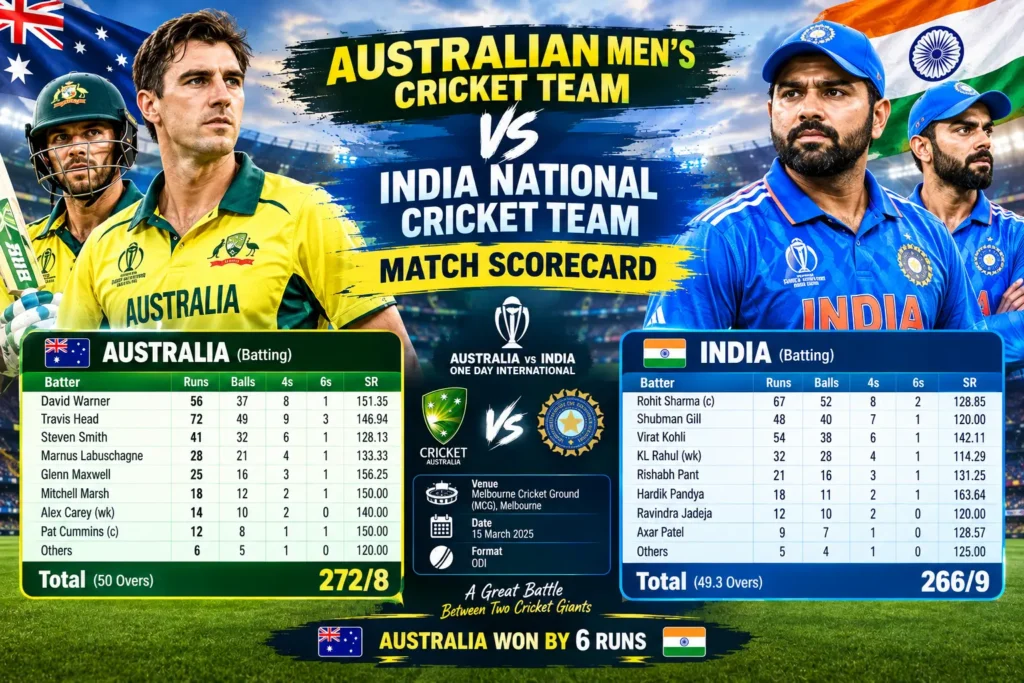
The Australian men’s cricket team vs India national cricket team match scorecard provides a complete overview of the batting, bowling, match result and standout performances from one of cricket’s most competitive international rivalries. Australia and India have a long history of memorable Test matches, One Day Internationals (ODIs) and Twenty20 Internationals (T20Is), featuring world-class batters, fast bowlers and match-winning all-rounders.
This page covers the third ODI between Australia and India played at the Sydney Cricket Ground on 25 October 2025. India won the match by nine wickets after chasing Australia’s total of 236 runs in 38.3 overs. Rohit Sharma scored an unbeaten 121, while Virat Kohli contributed an unbeaten 74 to guide India to victory.
The match was particularly memorable because India produced a strong bowling performance before its experienced batting pair controlled the chase. Although Australia lost the match, the team had already secured the three-match ODI series by winning the first two games.
Australia vs India 3rd ODI Match Summary
The third ODI took place during India’s 2025 tour of Australia. Australia won the toss and elected to bat first at the Sydney Cricket Ground. The hosts started positively but could not maintain their momentum throughout the innings. Matt Renshaw top-scored for Australia with 56 runs, while Mitchell Marsh contributed 41.
India’s bowlers applied pressure during the middle and final stages of the Australian innings. Harshit Rana claimed four wickets, and Washington Sundar took two, helping India dismiss Australia for 236 in 46.4 overs.
India began its chase with a positive approach. Shubman Gill scored 24 before being dismissed, but Rohit Sharma and Virat Kohli then built an unbeaten partnership that took India comfortably past the target. Rohit finished on 121 not out, and Kohli remained unbeaten on 74.
Match Information
| Match Detail | Information |
| Match | Australia vs India, 3rd ODI |
| Date | 25 October 2025 |
| Format | One Day International |
| Series | India tour of Australia 2025 |
| Venue | Sydney Cricket Ground, Sydney |
| Toss | Australia won and elected to bat |
| Australia Score | 236 all out in 46.4 overs |
| India Score | 237/1 in 38.3 overs |
| Match Result | India won by 9 wickets |
| Player of the Match | Rohit Sharma |
| ODI Series Result | Australia won 2–1 |
For the complete match record, including detailed scorecard information and commentary, visit the ESPNcricinfo Australia vs India 3rd ODI scorecard.
Australia Innings Scorecard
Australia started its innings with the aim of setting a competitive target. Travis Head and Mitchell Marsh provided an attacking start, but India’s bowlers gradually gained control. Several Australian batters made useful contributions, yet the team could not build enough substantial partnerships to reach a higher total.
Matt Renshaw was Australia’s leading run-scorer with 56 from 58 balls. Mitchell Marsh made 41, while Matthew Short scored 30. Australia eventually finished on 236 runs in 46.4 overs.
Australia Batting Scorecard
| Batter | Dismissal | Runs | Balls | 4s | 6s | Strike Rate |
| Travis Head | c Prasidh Krishna b Mohammed Siraj | 29 | 25 | 6 | 0 | 116.00 |
| Mitchell Marsh | b Axar Patel | 41 | 50 | 5 | 1 | 82.00 |
| Matthew Short | c Kohli b Washington Sundar | 30 | 41 | 2 | 0 | 73.17 |
| Matt Renshaw | lbw b Washington Sundar | 56 | 58 | 2 | 0 | 96.55 |
| Alex Carey | c Iyer b Harshit Rana | 24 | 37 | 1 | 0 | 64.86 |
| Cooper Connolly | c Kohli b Harshit Rana | 23 | 34 | 2 | 0 | 67.65 |
| Mitchell Owen | c Sharma b Harshit Rana | 1 | 4 | 0 | 0 | 25.00 |
| Mitchell Starc | b Kuldeep Yadav | 2 | 5 | 0 | 0 | 40.00 |
| Nathan Ellis | c Sharma b Prasidh Krishna | 16 | 19 | 3 | 0 | 84.21 |
| Adam Zampa | Not out | 2 | 5 | 0 | 0 | 40.00 |
| Josh Hazlewood | b Harshit Rana | 0 | 2 | 0 | 0 | 0.00 |
Extras: 12
Total: 236 all out in 46.4 overs
Australia’s Top Batting Performances
Matt Renshaw played the most productive innings for Australia, scoring 56 runs from 58 deliveries. His half-century helped the hosts recover after losing wickets during the middle overs. Renshaw used a combination of controlled stroke play and well-timed boundaries to keep the innings moving.
Mitchell Marsh contributed 41 runs from 50 balls. As captain, he was expected to provide a solid platform at the top of the order. Travis Head added 29 from 25 deliveries, giving Australia an early burst of scoring, while Matthew Short made 30 before being dismissed by Washington Sundar.
Alex Carey and Cooper Connolly also added useful runs, but neither could turn their start into a major innings. Australia’s lower order struggled against India’s disciplined bowling, and the final wickets fell before the team could complete its 50 overs.
India Bowling Scorecard
India’s bowling performance was a major factor in the result. The bowlers took wickets at important moments, prevented Australia from building a large total and restricted the hosts to 236 runs.
| Bowler | Overs | Maidens | Runs | Wickets | Economy |
| Mohammed Siraj | 5.0 | 1 | 24 | 1 | 4.80 |
| Harshit Rana | 8.4 | 0 | 39 | 4 | 4.50 |
| Prasidh Krishna | 7.0 | 0 | 52 | 1 | 7.42 |
| Kuldeep Yadav | 10.0 | 0 | 50 | 1 | 5.00 |
| Axar Patel | 6.0 | 0 | 18 | 1 | 3.00 |
| Washington Sundar | 10.0 | 2 | 44 | 2 | 4.40 |
Harshit Rana was India’s leading wicket-taker, finishing with figures of four wickets for 39 runs. He removed important Australian batters and helped finish the innings by taking wickets in the lower order.
Washington Sundar took two wickets for 44 runs in ten overs. His dismissals of Matthew Short and Matt Renshaw were particularly important because both batters had the potential to build a larger score. Axar Patel also bowled economically, conceding just 18 runs in six overs and dismissing Mitchell Marsh.
The combined effort of India’s seamers and spinners prevented Australia from taking full advantage of its batting starts.
Read More: West Indies Cricket Team vs India National Cricket Team Match Scorecard
India Innings Scorecard
India needed 237 runs to win the match. The opening partnership gave the team a reasonable start, although Josh Hazlewood dismissed Shubman Gill for 24. That wicket proved to be Australia’s only breakthrough of the innings.
Rohit Sharma and Virat Kohli then took control. They rotated the strike effectively, punished loose deliveries and built a partnership that removed any realistic pressure from the chase. India reached 237/1 in 38.3 overs, winning with 69 balls remaining.
India Batting Scorecard
| Batter | Dismissal | Runs | Balls | 4s | 6s | Strike Rate |
| Rohit Sharma | Not out | 121 | 125 | 13 | 3 | 96.80 |
| Shubman Gill | c Alex Carey b Josh Hazlewood | 24 | 26 | 2 | 1 | 92.31 |
| Virat Kohli | Not out | 74 | 81 | 7 | 0 | 91.36 |
Extras: 18
Total: 237/1 in 38.3 overs
Fall of wickets: 69/1 — Shubman Gill, 10.2 overs.
Did not bat: Shreyas Iyer, Axar Patel, KL Rahul, Washington Sundar, Harshit Rana, Kuldeep Yadav, Prasidh Krishna and Mohammed Siraj.
Australia Bowling Scorecard
| Bowler | Overs | Maidens | Runs | Wickets | Economy |
| Mitchell Starc | 5.0 | 0 | 31 | 0 | 6.20 |
| Josh Hazlewood | 6.0 | 1 | 23 | 1 | 3.83 |
| Nathan Ellis | 7.3 | 0 | 60 | 0 | 8.00 |
| Cooper Connolly | 5.0 | 0 | 36 | 0 | 7.20 |
| Adam Zampa | 10.0 | 0 | 50 | 0 | 5.00 |
| Mitchell Owen | 1.0 | 0 | 2 | 0 | 2.00 |
| Matthew Short | 4.0 | 0 | 29 | 0 | 7.25 |
Josh Hazlewood was the only Australian bowler to take a wicket. He dismissed Shubman Gill and finished with figures of one for 23 in six overs. He also bowled one maiden over, but Australia could not make further breakthroughs.
Nathan Ellis conceded 60 runs in 7.3 overs, while Adam Zampa bowled his full ten overs without taking a wicket. Once Rohit and Kohli settled at the crease, Australia struggled to create pressure or force mistakes.
How India Chased Australia’s Target
India’s chase was built around patience, shot selection and an excellent partnership between two experienced batters. The target of 237 was achievable, but Australia still needed early wickets to put pressure on India’s middle order.
Shubman Gill and Rohit Sharma initially gave India a steady start. Gill scored 24 runs from 26 balls before Josh Hazlewood found a way past his defence. At 69/1, Australia had an opportunity to put pressure on the incoming batter.
However, Virat Kohli joined Rohit and the pair gradually took the match away from Australia. Both players found gaps in the field, rotated the strike and punished deliveries that were too short or too wide. Their partnership grew without requiring an unnecessarily aggressive approach.
Rohit brought up his century from 105 balls and continued batting until the end. Kohli reached 74 not out from 81 deliveries, providing support while keeping the required run rate under control. The pair added an unbeaten 168-run partnership, and India reached its target in 38.3 overs.
The result demonstrated how experienced batters can manage a run chase by combining boundary scoring with low-risk singles and doubles.
Rohit Sharma’s Match-Winning Century
Rohit Sharma was named Player of the Match after producing one of the standout batting performances of the series. His unbeaten 121 came from 125 balls and included 13 fours and three sixes.
His innings was important not only because of the number of runs but also because of the way he controlled the chase. Rohit did not need to take unnecessary risks once India had established a strong position. Instead, he continued to find scoring opportunities and maintained a high level of control against Australia’s bowling attack.
Rohit reached his century from 105 balls and remained unbeaten until the winning runs were scored. His innings gave India the stability needed to complete the chase comfortably.
The performance also highlighted his ability to adapt his approach to the situation. He combined conventional strokes with attacking shots when Australia offered opportunities, ensuring the required run rate never became a major concern.
Virat Kohli’s Unbeaten 74
Virat Kohli played an important supporting role in India’s successful chase. He scored 74 not out from 81 balls, including seven fours. His innings was measured and consistent, allowing him to build a partnership with Rohit without putting unnecessary pressure on the scoring rate.
Kohli’s experience was valuable after Gill’s dismissal. Rather than forcing the pace immediately, he worked the ball into gaps, selected suitable deliveries to attack and helped India move closer to the target.
His partnership with Rohit also gave the team a dependable second-wicket stand. Once the pair had settled, Australia found it increasingly difficult to create chances. Kohli remained unbeaten as India secured the nine-wicket victory.
Harshit Rana’s Four-Wicket Performance
Harshit Rana was India’s most successful bowler in the match. His figures of 4/39 in 8.4 overs helped restrict Australia to a total that India could chase comfortably.
Rana’s wickets came at useful moments, including the dismissals of Alex Carey, Cooper Connolly, Mitchell Owen and Josh Hazlewood. Taking wickets in the middle and lower order prevented Australia from extending its innings and building a more challenging total.
His performance was supported by Washington Sundar, who took two wickets, and the rest of India’s bowling unit. Together, they kept Australia below 250 and gave the batters a manageable target.
For a limited-overs match, restricting the opposition to 236 was a significant achievement, particularly after Australia had made promising starts through several batters.
Key Turning Points in Australia vs India 3rd ODI
1. India Removed Key Batters at the Right Time
Australia had several batters who reached double figures, but most were unable to convert their starts into major scores. India’s bowlers broke partnerships before they could develop into match-defining stands.
2. Matt Renshaw’s Half-Century Kept Australia Competitive
Renshaw’s 56 was Australia’s highest individual score. His innings helped the hosts recover during the middle overs, but Australia needed a larger contribution from the other batters to post a more challenging total.
3. Harshit Rana Finished the Australian Innings Strongly
Rana’s four wickets helped India dismiss Australia in 46.4 overs. His ability to remove lower-order batters prevented the hosts from adding valuable runs at the end.
4. Rohit Sharma and Virat Kohli Built a Match-Winning Partnership
The unbeaten 168-run partnership was the defining phase of India’s chase. After Gill’s dismissal, Australia could not take another wicket, allowing the two senior batters to control the match.
5. India Reached the Target with 69 Balls Remaining
India’s total of 237/1 in 38.3 overs meant the team won by nine wickets with 69 balls remaining. The margin reflected the difference between the two sides’ batting performances in this match.
Australia vs India ODI Series Result
Although India won the third ODI, Australia won the three-match series 2–1. Australia had already won the first two matches, so India’s victory in Sydney served as a strong finish rather than a series win.
The third ODI was still significant for India because it demonstrated the team’s ability to recover after two defeats. The bowlers restricted Australia to 236, and the batters completed the chase with only one wicket lost.
For Australia, the series victory remained the main achievement. The hosts won the series despite losing the final match by a substantial margin. The result also showed that a team can lose an individual game while still winning a multi-match series through consistency across earlier fixtures.
Readers looking for the wider international context can consult the International Cricket Council’s official match and tournament coverage.
Australia vs India Head-to-Head: Understanding the Rivalry
Australia and India are two of the most prominent teams in international cricket. Their rivalry spans Test cricket, ODIs and T20Is, with each format producing different types of contests.
In Test cricket, matches between these teams often involve extended battles between fast bowlers, specialist batters and spinners. Conditions in Australia can provide extra bounce and pace, while Indian pitches often bring spin and reverse swing into the contest.
ODIs require teams to balance wicket preservation with scoring opportunities across 50 overs. The Sydney match demonstrated this balance: Australia made 236, but India’s batters chased the total without taking major risks.
T20Is are shorter and usually place greater emphasis on power hitting, rapid scoring and tactical bowling changes. Results can shift quickly because a few overs can significantly change the required run rate.
A useful head-to-head section should present separate records for Tests, ODIs and T20Is. It should include the total matches played, wins for each team, draws in Tests, and ties or no-results where applicable. These statistics should be updated from a reliable cricket database before publication, as totals change whenever the teams play another international match.
How to Read an Australia vs India Match Scorecard
A cricket scorecard contains several abbreviations that help readers understand each player’s contribution.
- R (Runs): The number of runs scored by a batter.
- B (Balls): The number of deliveries faced.
- 4s: The number of boundaries hit for four runs.
- 6s: The number of sixes hit.
- SR (Strike Rate): Runs scored per 100 balls faced.
- O (Overs): The number of overs bowled by a bowler.
- M (Maidens): Overs in which the bowler conceded no runs from the bat or other scoring deliveries, according to standard scorekeeping rules.
- W (Wickets): The number of wickets taken by a bowler.
- Econ (Economy): The average runs conceded per over.
- Extras: Runs added through wides, no-balls, byes, leg-byes and other extras.
- Fall of Wickets: The score and over at which each batter was dismissed.
For example, Rohit Sharma’s 121 from 125 balls means he scored 121 runs while facing 125 deliveries. His strike rate of 96.80 indicates that he scored at a rate of 96.8 runs per 100 balls.
Similarly, Harshit Rana’s figures of 4/39 mean that he took four wickets and conceded 39 runs. His economy rate of 4.50 means he conceded an average of 4.5 runs per over.
Understanding these terms makes it easier to compare performances across different matches and formats.
Frequently Asked Questions
Who won the Australia vs India 3rd ODI in 2025?
India won the third ODI against Australia on 25 October 2025 by nine wickets. India chased Australia’s total of 236 and finished on 237/1 in 38.3 overs.
What was Australia’s score against India?
Australia scored 236 runs and was all out in 46.4 overs. Matt Renshaw was the leading scorer with 56 runs, followed by Mitchell Marsh with 41.
What was India’s score against Australia?
India scored 237/1 in 38.3 overs while chasing a target of 237. Rohit Sharma remained unbeaten on 121, and Virat Kohli finished on 74 not out.
Who was Player of the Match?
Rohit Sharma was named Player of the Match for his unbeaten 121 from 125 balls. His innings helped India complete the chase comfortably.
How many wickets did Harshit Rana take?
Harshit Rana took four wickets for 39 runs in 8.4 overs. He was India’s leading wicket-taker in the match.
How many runs did Virat Kohli score?
Virat Kohli scored 74 not out from 81 balls, hitting seven fours. He partnered with Rohit Sharma to guide India to victory.
Where was the Australia vs India 3rd ODI played?
The match was played at the Sydney Cricket Ground in Sydney, Australia, on 25 October 2025.
Did India win the entire ODI series?
No. India won the third ODI, but Australia won the three-match series 2–1 after taking the first two matches.
Where can I find a complete Australia vs India scorecard?
A complete scorecard should include each batter’s runs, balls faced, boundaries, dismissals, bowling figures, extras, fall of wickets and match result. The ESPNcricinfo scorecard linked above provides detailed match statistics for this specific ODI.
What is the difference between an ODI and a T20I scorecard?
An ODI is normally played over a maximum of 50 overs per team, while a T20I is played over a maximum of 20 overs per team. Their scorecards use similar batting and bowling statistics, but the shorter format generally involves a faster scoring rate.
Final Match Summary
The Australia vs India third ODI on 25 October 2025 delivered a convincing win for India at the Sydney Cricket Ground. Australia scored 236 in 46.4 overs, with Matt Renshaw making 56 and Mitchell Marsh adding 41. India’s bowlers, led by Harshit Rana’s 4/39, prevented the hosts from reaching a bigger total.
India then chased the target with nine wickets in hand. Rohit Sharma scored an unbeaten 121, while Virat Kohli contributed 74 not out. Their partnership ensured that India reached 237/1 in 38.3 overs, winning with 69 balls remaining.
Despite the defeat, Australia finished the ODI series as winners by a 2–1 margin. This match remains a useful example of how disciplined bowling and a strong batting partnership can turn a competitive target into a comfortable victory.
Editorial update recommendation: If this page is intended to rank for the broad keyword “Australian men’s cricket team vs India national cricket team match scorecard,” label this as the 3rd ODI scorecard in the heading and add links to separate Test, ODI and T20I scorecard pages as those pages are published. Update the page when new matches take place, and verify scorecard data before each revision.