
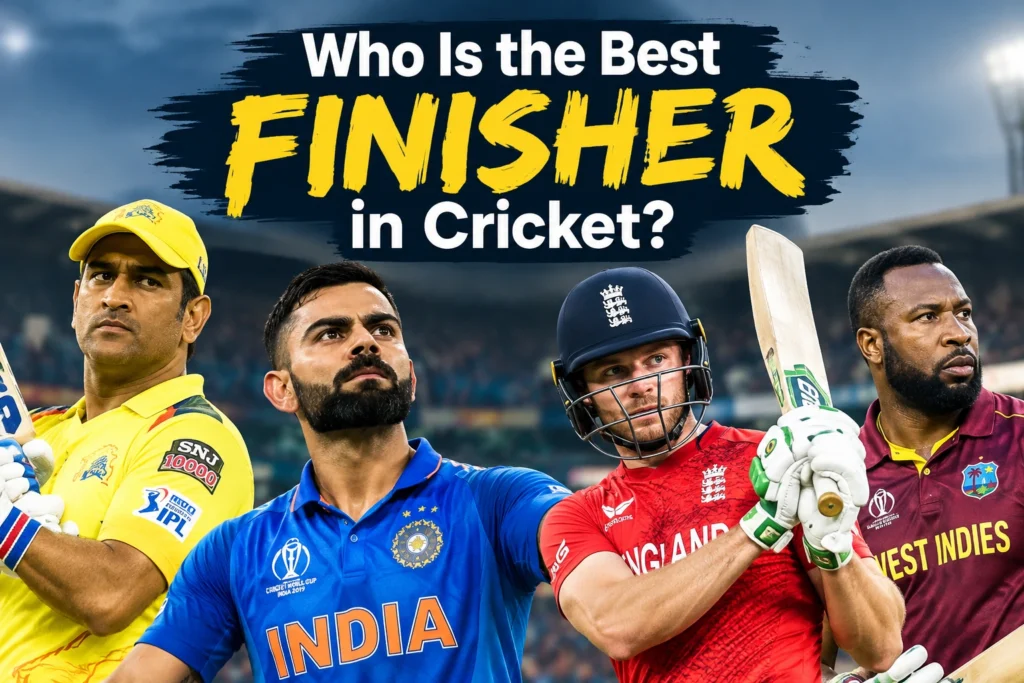
Cricket is a game of skill, patience, timing, and pressure management. While opening batters often receive attention for building strong starts and middle-order players are praised for stabilizing an innings, finishers have a different responsibility: taking their team across the finish line when the match is on the line. This is why cricket fans frequently ask, who is the best finisher in cricket?
Several legendary players have earned this reputation through their ability to chase difficult targets, score quick runs in the final overs, and remain calm when a match reaches its most challenging stage. MS Dhoni is widely regarded as one of the greatest finishers in cricket history, thanks to his remarkable composure, successful run chases, and memorable match-winning performances. Michael Bevan, AB de Villiers, Michael Hussey, Kieron Pollard, and Andre Russell have also established strong cases in different formats.
However, identifying the best finisher in the world is not as simple as comparing sixes or strike rates. A great finisher must understand the match situation, calculate risks, manage the required run rate, and deliver when the team needs them most.
In this article, we explore the top 10 finishers in cricket history, examine their strengths, compare famous players, and explain what makes someone an exceptional finisher in international cricket, T20 cricket, and the Indian Premier League.
Who Is the Best Finisher in Cricket?
MS Dhoni is the strongest overall candidate for the title of the best finisher in cricket history. His reputation comes from his ability to guide difficult chases, control the pace of an innings, and remain composed during high-pressure situations. His unbeaten 91 against Sri Lanka in the 2011 Cricket World Cup final, which ended with a match-winning six, remains one of the most memorable finishing performances in international cricket history. ICC’s report on Dhoni’s World Cup final innings documents the significance of that performance.
Dhoni’s finishing approach is based on more than power hitting. He often allows a chase to develop, studies the opposition’s bowling options, and chooses the right moments to attack. His ability to remain at the crease until the final overs also gives his teammates confidence.
Michael Bevan deserves recognition for establishing the modern reputation of the specialist ODI finisher. AB de Villiers brought extraordinary shot-making ability, while players such as Kieron Pollard and Andre Russell became famous for their explosive T20 performances.
There is no official ICC award that permanently identifies one player as the greatest finisher. The answer depends on the format, era, statistics, and criteria used. Nevertheless, Dhoni’s combination of longevity, memorable finishes, and successful chase management makes him a compelling choice for the all-time number-one position.
What Makes a Great Finisher in Cricket?
A finisher is usually a middle-order or lower-middle-order batter who helps a team complete a successful chase or accelerate its scoring during the closing overs. The role requires a combination of technical ability, tactical awareness, and mental strength.
1. Staying Calm Under Pressure
A finisher may walk to the crease with the team needing 70 runs from the final eight overs or 15 runs from the last over. In these situations, panic can lead to poor shot selection and unnecessary wickets. Great finishers remain composed and focus on the next delivery rather than the entire target.
2. Understanding the Required Run Rate
An experienced finisher knows when to take singles, when to rotate the strike, and when to attack. A chase is not always won by hitting boundaries every ball. Sometimes, preserving wickets and building a partnership creates a better opportunity to accelerate later.
3. Power Hitting and Shot Selection
Modern limited-overs cricket rewards batters who can clear the boundary against different bowling styles. However, power alone does not make someone the best finisher in the world. Timing, placement, adaptability, and the ability to read a bowler’s plan are equally important.
4. Delivering in Successful Chases
The most important responsibility of a finisher is to help the team win. A spectacular unbeaten innings in a losing cause can demonstrate skill, but repeatedly contributing to successful chases builds a stronger finishing legacy.
5. Consistency Across Match Situations
Great finishers can adapt to different pitches, batting positions, targets, and bowling attacks. The ability to rescue a struggling innings and accelerate an already strong one makes a player valuable in both ODI and T20 cricket.
Read More: Which IPL Team Has Most Fans in India
Top 10 Best Finishers in Cricket History
The following list is an editorial ranking based on finishing ability, match impact, adaptability, memorable performances, and reputation. It is not an official international ranking, and players from different eras cannot be compared perfectly.
1. MS Dhoni — India’s Legendary Finisher
MS Dhoni is often the first name mentioned when fans discuss the best finisher in cricket. His limited-overs career demonstrated an unusual ability to assess a chase, preserve his wicket, and take responsibility during the closing stages of a match.
One of his most iconic performances came in the 2011 World Cup final against Sri Lanka. Promoted up the batting order, Dhoni scored an unbeaten 91 and finished the chase with a six. The innings combined calculated aggression with outstanding composure under pressure.
Dhoni’s reputation also grew through India’s ODI performances and his long association with Chennai Super Kings in the IPL. He was capable of taking a game deep, using the lower-order partnership effectively, and attacking when the situation demanded it.
His finishing style was not always about scoring the fastest possible runs. Instead, it focused on giving his team the best chance of winning. That combination of game awareness, confidence, and memorable results makes him the leading choice in this list.
2. Michael Bevan — The Original ODI Finisher
Michael Bevan is widely recognized as one of the defining finishers of ODI cricket. Playing for Australia before T20 cricket became a major global format, he developed a reputation for controlling run chases through patience, precision, and intelligent running between the wickets.
Bevan did not always rely on spectacular six-hitting. Instead, he worked the ball into gaps, collected singles, found boundaries when needed, and protected his wicket. His ability to manage the chase made him particularly valuable when Australia lost early wickets.
The ICC’s profile of Michael Bevan highlights several of his important unbeaten innings, including performances that rescued Australia from difficult positions.
Bevan’s contribution to the evolution of the specialist finisher should not be overlooked. While Dhoni is the stronger overall choice for this article, Bevan has one of the strongest cases for the best ODI finisher of his generation.
3. AB de Villiers — The 360-Degree Match Winner
AB de Villiers was one of the most innovative batters in modern cricket. Known for his ability to score around the ground, he could use conventional strokes, reverse shots, scoops, and unconventional angles to disrupt a bowler’s plans.
His versatility made him dangerous in ODI and T20 cricket. He could build an innings when wickets fell early or accelerate dramatically when his team needed quick runs. His performances for South Africa and Royal Challengers Bengaluru also established his reputation among franchise cricket fans.
Compared with Dhoni, de Villiers generally offered a different kind of finishing threat. Dhoni became famous for controlling pressure and taking games deep, while de Villiers could change the scoring rate in a very short period.
For fans who value attacking range, creativity, and rapid scoring, AB de Villiers has a strong claim to being the greatest finisher. His exact position depends on whether the ranking emphasizes successful chases or overall explosive impact.
4. Michael Hussey — Mr Cricket
Michael Hussey earned a reputation as a dependable and technically accomplished batter for Australia. His experience, calm temperament, and ability to handle pressure made him effective in different limited-overs situations.
Hussey could stabilize an innings after early wickets and then increase the scoring rate as the innings progressed. He was also comfortable batting alongside lower-order players, which is a valuable skill for a specialist finisher.
His finishing ability was particularly useful because he did not always need to dominate every delivery. He could identify scoring opportunities, maintain partnerships, and punish mistakes from bowlers.
Although he is sometimes less prominent in discussions about the best finisher in the world than Dhoni or de Villiers, Hussey remains an important example of how intelligence and consistency can be as valuable as raw power.
5. Kieron Pollard — The Power-Hitting Finisher
Kieron Pollard became one of the most recognizable finishing specialists in franchise T20 cricket. His strength, reach, and ability to hit sixes over different parts of the ground made him a dangerous batter during the final overs.
Pollard was particularly effective when his team needed a rapid increase in scoring. A few powerful shots could transform a competitive total into a challenging target or bring an apparently difficult chase back within reach.
His experience in leagues around the world also exposed him to different pitches, bowling styles, and tactical situations. This made him an influential figure in the development of modern T20 finishing.
However, finishing is not only about hitting the longest six. The best performances also involve choosing the right balls to attack and avoiding unnecessary risks. Pollard’s power-hitting legacy places him among the leading T20 finishers, even though different fans may rank him differently from Dhoni.
6. Andre Russell — The Explosive T20 Finisher
Andre Russell is renowned for his exceptional power and ability to score quickly during the death overs. In T20 cricket, he can change a match within a few deliveries, making him one of the most feared late-innings batters in franchise competitions.
Russell’s finishing style depends heavily on aggressive intent. He can attack pace and spin, clear the boundary from difficult positions, and force bowlers to change their plans. His all-round abilities also add value to teams beyond his batting.
Unlike a traditional ODI finisher who may need to manage a chase over several overs, Russell often operates in situations where the scoring rate must rise immediately. His role illustrates how the definition of a finisher has evolved with T20 cricket.
Russell is one of the strongest candidates for the best T20 finisher, particularly when explosive scoring and death-over impact receive greater weight than long-form consistency.
7. David Miller — The Reliable Left-Handed Finisher
David Miller has built his reputation on powerful hitting, confident decision-making, and an ability to score under pressure. His left-handed batting adds variety to a middle order and can create different angles for bowlers to defend.
Miller has shown that a successful finisher needs both aggression and patience. He can take calculated risks, target particular bowlers, and use the final overs to close a gap in the required run rate.
His performances in international and franchise cricket have made him a familiar name in discussions about the best finishers in the world. He is especially valuable when a team needs someone who can accelerate without completely abandoning the plan of the innings.
Miller may not have the same all-time profile as Dhoni, but his ability to deliver powerful late-innings contributions makes him an important modern finishing specialist.
8. Lance Klusener — The Powerful All-Round Finisher
Lance Klusener was one of South Africa’s most influential limited-overs all-rounders during the late 1990s and early 2000s. His aggressive batting and ability to contribute in difficult situations made him a valuable lower-order player.
Klusener could score rapidly when the innings needed acceleration, but he also understood the importance of keeping a chase alive. His all-round contribution meant he could influence a match with both bat and ball.
His finishing reputation was shaped in an era when ODI teams relied on a combination of power, tactical awareness, and strong lower-order batting to close matches. He is an important part of the history of limited-overs finishing.
Although modern T20 players may have more opportunities to hit boundaries at extreme rates, Klusener’s influence belongs in any broad discussion of the greatest finishers in cricket history.
9. Hardik Pandya — The Modern Indian Finisher
Hardik Pandya represents the modern all-round finisher: a batter who can contribute quick runs, attack in the final overs, and provide a team with additional bowling options.
His finishing role varies according to the format and match situation. In T20 cricket, he may be required to accelerate immediately, while in ODIs he can sometimes build a partnership before increasing the scoring rate.
Hardik’s value also comes from his ability to change a team’s balance. A strong finisher who can bowl gives selectors greater flexibility when building a limited-overs side.
Like other active players, his position in an all-time ranking should depend on performances across time rather than a few standout innings. Nevertheless, he remains a relevant name when discussing modern Indian finishers and the evolving demands of white-ball cricket.
10. Rinku Singh — An Emerging Finishing Specialist
Rinku Singh has attracted attention for his ability to score quickly in high-pressure T20 situations. His performances have shown how a batter can remain focused even when a team needs a large number of runs in the closing overs.
One of the qualities associated with Rinku is his willingness to back his shot selection. When the opportunity appears, he can target the boundary rather than allowing the required run rate to become unmanageable.
His career is still developing compared with the long international records of Dhoni, Bevan, and de Villiers. Therefore, it would be premature to place him above established legends on an all-time basis.
However, his emergence illustrates the continuing importance of specialist finishers in modern T20 cricket, where games can turn dramatically in the final few overs.
MS Dhoni vs AB de Villiers: Who Is the Better Finisher?
The comparison between MS Dhoni and AB de Villiers is one of the most popular debates among cricket fans. Both players possessed extraordinary batting ability, but their finishing styles were different.
Dhoni’s greatest strength was his control of the chase. He frequently looked to understand the required rate, keep wickets in hand, and take responsibility for the final stages. His famous 2011 World Cup final innings remains an example of how composure and timing can decide a major match.
De Villiers, on the other hand, offered extraordinary attacking flexibility. His ability to find gaps and use unconventional shots made him difficult to predict. He could increase the scoring rate rapidly and put pressure on bowlers who had already executed their plans well.
| Comparison factor | MS Dhoni | AB de Villiers |
|---|---|---|
| Signature strength | Chase management | Innovative attacking shots |
| Finishing style | Calculated and composed | Explosive and adaptable |
| Famous achievement | 2011 World Cup final innings | Outstanding ODI and T20 batting |
| Best argument | Closing difficult matches | Changing the game rapidly |
If the main criterion is finishing successful chases and managing pressure, Dhoni has the stronger case. If the focus is attacking creativity and the ability to score rapidly from unusual positions, de Villiers is an outstanding choice.
For an all-time ranking that considers both legacy and match-finishing ability, Dhoni narrowly takes the lead.
MS Dhoni vs Michael Bevan: The Original vs the Modern Icon
Michael Bevan and MS Dhoni represent two important stages in the development of the specialist finisher.
Bevan demonstrated how a batter could rescue an ODI chase through careful calculation, intelligent running, and an ability to stay at the crease. He did not need to hit a large number of sixes to remain effective. His approach was based on keeping the chase under control and avoiding unnecessary risks.
Dhoni used several similar principles but played in a period with different scoring expectations, more extensive T20 cricket, and greater attention on power hitting. He combined traditional chase management with the ability to accelerate dramatically at the end.
Comparing them directly is difficult because their playing conditions and eras were different. Bevan’s ODI record and influence on the role make him a major contender for the best ODI finisher of all time. Dhoni’s international achievements, iconic finishes, and IPL legacy give him a broader claim across limited-overs cricket.
Both players show that the best finisher is not necessarily the batter who hits the most sixes. The real objective is to give the team the greatest chance of winning.
Who Is the Best Finisher in ODI Cricket?
ODI cricket demands a different kind of finishing ability from T20 cricket. A player may need to manage a chase over 10 or 15 overs rather than attack every delivery from the beginning.
Michael Bevan is a leading candidate for the best ODI finisher because of his ability to build successful chases through careful batting. His ODI career included 6,912 runs at an average of 53.58, according to Cricbuzz’s career statistics. Those figures help explain why he remains an important name in discussions about limited-overs batting.
MS Dhoni also has a powerful case. His ability to remain unbeaten, manage the lower order, and finish major matches made him one of India’s most effective ODI batters.
The strongest choice depends on the definition used. Bevan is often regarded as the prototype ODI finisher, while Dhoni is a leading candidate for the greatest overall finisher. Both deserve recognition for showing how strategy and composure can be as important as attacking ability.
Who Is the Best Finisher in T20 Cricket?
T20 cricket places greater emphasis on rapid scoring, boundary hitting, and the ability to change a match within a small number of deliveries. As a result, the best T20 finisher may have a different profile from the best ODI finisher.
Kieron Pollard and Andre Russell are famous for their power hitting, while David Miller has built a reputation for delivering important late-innings contributions. AB de Villiers also demonstrated how unconventional shot-making could disrupt bowling plans.
Dhoni remains a major candidate because of his experience, game awareness, and long association with the IPL. His finishing ability is based not only on power but also on understanding when to attack and how to manage pressure.
There is no single answer that fits every T20 league, season, and match situation. A fair ranking should consider death-over strike rate, consistency, the difficulty of the situation, and how often a player’s contribution leads to a win.
For explosive power hitting, Russell and Pollard have strong cases. For a combination of experience, tactical awareness, and a long finishing legacy, Dhoni remains a leading choice.
Who Is the Best Finisher in IPL History?
The Indian Premier League has played a major role in shaping modern finishing. The tournament regularly places batters in situations where they must score quickly against specialist death bowlers, often with only a few wickets remaining.
MS Dhoni is one of the most prominent candidates for the best finisher in IPL history. His long association with Chennai Super Kings and his ability to guide difficult chases have made him a central figure in the tournament’s finishing legacy.
AB de Villiers also deserves consideration because of his attacking range and ability to score rapidly against different bowling styles. Kieron Pollard and Andre Russell have been influential through their power hitting, while David Miller has produced important contributions in pressure situations.
A fair comparison should not rely only on total runs or the number of sixes. It should also consider batting position, runs scored in the final overs, the match situation when a player arrives, and the number of successful finishes.
The best IPL finisher may differ according to the season or statistical method. However, Dhoni remains one of the strongest all-time choices because his role has consistently been associated with closing games and managing pressure.
Statistics That Help Identify the Best Finisher in Cricket
Statistics can make the debate more objective, but no single number completely captures finishing ability.
Successful chases: This shows how often a player has contributed when a team is pursuing a target. It is useful, but team strength and batting partners also affect results.
Batting average while chasing: A strong average can indicate consistency, particularly when a player frequently bats under pressure. It should be examined alongside strike rate and match outcomes.
Strike rate in the final overs: This helps evaluate how quickly a batter scores when the innings is approaching its conclusion. The number of balls faced and the wickets available also matter.
Not-out innings in wins: Remaining unbeaten while helping a team win can be a useful indicator of finishing ability. However, not every not-out innings has the same level of difficulty.
Performance in knockout matches: World Cup and other knockout performances can reveal how a player handles pressure, although a small sample of matches should not determine an entire career ranking.
Match-winning contributions: The context of an innings matters. A player who scores 25 runs from 10 balls to win a close match may have a greater finishing impact than someone who scores more runs after the result is effectively decided.
A strong analysis combines these indicators with match footage, batting position, opposition quality, pitch conditions, and the required run rate.
Who Is the Best Finisher in Cricket in 2026?
For an all-time ranking in 2026, MS Dhoni remains the strongest overall choice in this article because of his successful chase management, memorable performances, and long-lasting reputation in limited-overs cricket.
However, the question of the best finisher in cricket in 2026 can also refer to current players. That requires a separate assessment of recent international matches, T20 leagues, and performances in the latest completed season.
Players such as Hardik Pandya, Rinku Singh, David Miller, Andre Russell, and other specialist middle-order batters may have different levels of impact depending on the competition and season. Their rankings should be based on up-to-date statistics rather than reputation alone.
It is also important to distinguish between the greatest finisher in cricket history and the best finisher currently in form. A legendary player may have the strongest career legacy, while another batter may be performing better in the present season.
For this reason, any current-player ranking should state its statistical cutoff date and the format being evaluated.
Final Verdict: Who Is the Greatest Finisher in Cricket?
So, who is the best finisher in cricket? MS Dhoni is our top overall choice, primarily because of his ability to manage difficult chases, remain composed under pressure, and deliver in memorable matches. His unbeaten 91 in the 2011 World Cup final remains a defining example of finishing ability.
Michael Bevan deserves recognition as one of the original masters of ODI finishing, while AB de Villiers stands out for his extraordinary attacking range. Pollard and Russell represent the power-hitting approach that has become especially important in T20 cricket.
Ultimately, the greatest finisher is not simply the player who hits the biggest six or scores at the highest strike rate. It is the player who understands the situation, makes the right decisions, and helps the team win when the pressure is greatest.
Dhoni’s overall legacy makes him the leading choice, although different formats and criteria can produce different answers.
Frequently Asked Questions
Who is the best finisher in cricket?
MS Dhoni is widely regarded as one of the greatest finishers in cricket history. His successful run chases, calm approach, and 2011 World Cup final performance support his position as the leading overall candidate.
Why is MS Dhoni called the best finisher?
Dhoni is known for his ability to read match situations, manage the required run rate, preserve his wicket, and accelerate at the right time. His memorable unbeaten 91 in the 2011 World Cup final is one of the strongest examples of his finishing ability.
Who is the original finisher in cricket?
Michael Bevan is widely recognized as one of the original specialist ODI finishers. His calculated batting and ability to guide Australia through difficult chases helped establish the role’s reputation.
Is MS Dhoni better than AB de Villiers as a finisher?
It depends on the criteria. Dhoni has a stronger case for chase management and overall finishing legacy, while AB de Villiers stands out for attacking creativity and rapid scoring. Both are among the most celebrated limited-overs batters.
Who is the best finisher in ODI cricket?
Michael Bevan and MS Dhoni are two of the strongest candidates. Bevan is known for his calculated ODI chases, while Dhoni combined chase management with major match-winning performances.
Who is the best finisher in T20 cricket?
There is no official winner. Dhoni, AB de Villiers, Kieron Pollard, Andre Russell, and David Miller all have strong cases, depending on whether the ranking emphasizes match-winning impact, consistency, or explosive death-over scoring.
Who is the best finisher in IPL history?
MS Dhoni is one of the strongest candidates because of his long IPL career and association with finishing matches for Chennai Super Kings. Other players, including AB de Villiers, Pollard, and Russell, also deserve consideration.
What makes someone a great finisher?
A great finisher combines composure, tactical awareness, power, shot selection, strike rotation, and the ability to deliver under pressure. The most important measure is how effectively the player helps the team reach a winning position.
Is there an official award for the best finisher in cricket?
No permanent official ICC award identifies the best finisher in cricket history. Rankings are generally based on statistics, match-winning performances, expert opinions, and individual criteria.